

Introduction
If you are a Gen Z woman trying to build a skincare routine, you have probably come across two names again and again: CeraVe and The Ordinary. Both brands are popular, relatively accessible, and known for products that target common concerns such as acne, dryness, dark spots, uneven texture, and sensitive skin.
But popularity does not automatically mean that one brand is better for everyone.
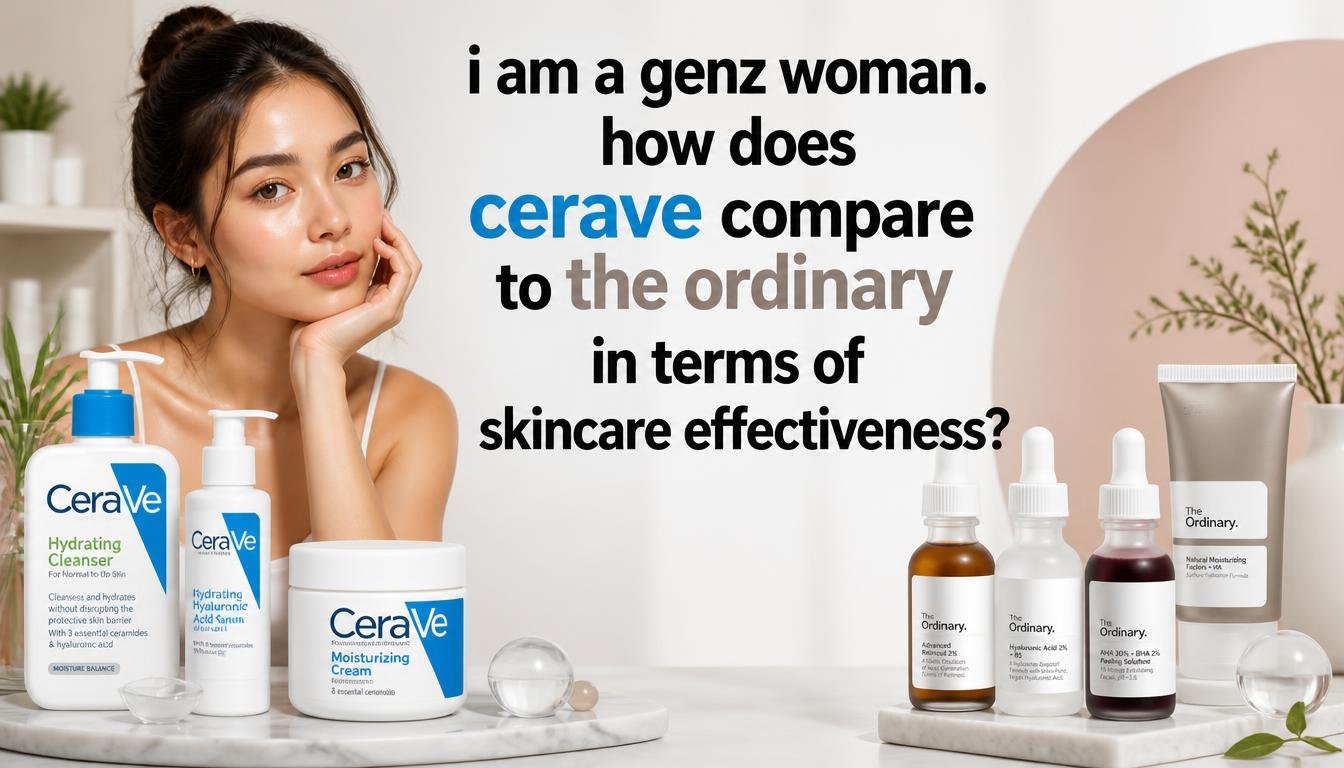
So, I am a Gen Z woman. How does CeraVe compare to The Ordinary in terms of skincare effectiveness? The simplest answer is that the two brands take somewhat different approaches. CeraVe is particularly well known for products built around skin-barrier support, including ceramides, while The Ordinary is widely recognized for targeted formulas centered on individual active ingredients. CeraVe says its skincare products contain three essential ceramides, while The Ordinary offers both targeted active treatments and newer barrier-focused products.
That difference matters.
If your biggest problem is dry, irritated, or sensitive skin, a simple barrier-supporting routine may make more sense. If your main goal is targeting a specific concern such as excess oil, congestion, uneven tone, or texture, a carefully selected active from The Ordinary may be useful.
The real question is not simply “Which brand is better?” It is “Which product and ingredient make sense for my skin right now?”
This guide compares CeraVe and The Ordinary by skin concern, beginner-friendliness, ingredients, budget, and routine compatibility so you can make a smarter choice without buying your entire bathroom cabinet.
CeraVe vs. The Ordinary: What’s the Biggest Difference?
Before comparing individual products, it helps to understand what each brand is generally trying to accomplish.
CeraVe places a major emphasis on maintaining the skin barrier. The brand says its products are developed with dermatologists and formulated around three essential ceramides, with many products also containing ingredients such as hyaluronic acid and niacinamide.
The Ordinary takes a more ingredient-focused approach. Instead of making every product feel like part of one standardized routine, the brand has built much of its identity around individual ingredients and targeted formulations.
That creates two very different experiences for someone shopping for skincare.
What CeraVe Focuses On
CeraVe is especially useful when the goal is to create a reliable foundation for a skincare routine.
Its product range includes cleansers, moisturizers, serums, sunscreens, and treatments. Many products include ceramides designed to support the skin’s natural barrier and help maintain moisture.
The skin barrier is important because it helps reduce moisture loss and protects the skin from external irritants. When it becomes compromised, skin can feel dry, rough, tight, or more sensitive.
That does not mean CeraVe is only for dry skin. The brand also makes products for oily, acne-prone, and combination skin. For example, its Foaming Facial Cleanser contains ceramides, hyaluronic acid, and niacinamide and is designed for normal-to-oily skin.
This makes CeraVe a practical option for someone who wants fewer complicated decisions.
What The Ordinary Focuses On
The Ordinary is attractive to people who like to understand exactly which ingredient they are putting on their skin.
Instead of simply buying a product because it is labeled for “glowing skin,” a shopper can choose a product based on a particular concern or ingredient.
For example, someone might look for niacinamide for an uneven-looking complexion or a salicylic-acid product for congestion.
This approach can be excellent when you know what you need.
The downside is that having many targeted options can make skincare more complicated. A beginner may see several acids, serums, retinoids, and other treatments and assume that using several of them together will produce faster results.
Usually, more products do not mean better skincare.
The Ordinary also should not be viewed as purely an “active-only” brand. It has barrier-supporting products too. Its Soothing & Barrier Support Serum, for example, contains ingredients including ceramides, niacinamide, centella asiatica, and vitamin B12.
Which Is More Effective for Acne and Breakouts?
Acne is one of the biggest reasons young adults start looking more closely at skincare ingredients.
The important thing to remember is that acne is not one single problem. Someone with occasional clogged pores may need a different approach from someone with persistent inflammatory acne.
CeraVe for Acne-Prone Skin
CeraVe can be a strong choice if acne-prone skin is also dry, irritated, or sensitive.
One reason is that acne routines can easily become too aggressive. A person may use an exfoliating cleanser, acne treatment, scrub, drying toner, and several other products at once. The result can be uncomfortable, irritated skin.
A basic cleanser and moisturizer can help provide the foundation around a targeted acne treatment.
CeraVe also has acne-focused products. Its official ingredient information lists salicylic acid and benzoyl peroxide among ingredients used in its acne-prone skin range. Its Acne Control Cleanser, for example, contains 2% salicylic acid.
For someone who wants an uncomplicated routine, that can be useful.
The Ordinary for Acne-Prone Skin
The Ordinary can be appealing if you want a targeted ingredient rather than a complete acne-focused system.
Niacinamide and salicylic acid are two ingredients that may appear in routines aimed at congestion, excess oil, or blemish-prone skin.
However, an ingredient-focused routine requires more responsibility.
For example, using multiple exfoliating products at once may increase irritation without necessarily producing better results. A better approach is to introduce one treatment at a time and give your skin enough time to show how it responds.
Which Should a Gen Z Beginner Choose?
If your skin is acne-prone and easily irritated, start simple.
A reasonable basic structure is:
- Gentle cleanser
- Moisturizer
- One targeted acne treatment if appropriate
- Sunscreen during the day
If acne is persistent, painful, severe, or leaving significant scars, skincare products may not be enough. A dermatologist can help determine whether prescription or other professional treatment is appropriate.
CeraVe vs. The Ordinary for Dryness and Sensitive Skin
Dryness and sensitivity are where the difference between a barrier-focused routine and an active-focused routine becomes especially important.
When skin feels tight, flaky, stings when products are applied, or becomes unusually reactive, adding more powerful treatments is not always the answer.
Sometimes the routine needs to become simpler.
CeraVe’s approach makes it particularly easy to build a barrier-supportive routine. The brand explains that ceramides are important components of the skin barrier and that its products use three essential ceramides.
Why CeraVe May Be the Better Starting Point
For dry skin, the first goal is often basic hydration and comfort.
A cleanser should remove dirt, sunscreen, and makeup without leaving the face feeling extremely tight. A moisturizer should help reduce moisture loss and keep the skin comfortable.
CeraVe’s Hydrating Facial Cleanser, for example, contains ceramides and hyaluronic acid and is designed to cleanse while maintaining moisture balance. It is also labeled non-comedogenic.
Its Daily Moisturizing Lotion also contains three essential ceramides and hyaluronic acid and is marketed as lightweight and non-comedogenic.
That kind of simple routine can be easier for someone who is new to skincare.
When The Ordinary Can Still Work for Sensitive Skin
Sensitive skin does not automatically mean you have to avoid The Ordinary.
The key is choosing the individual formula carefully.
The Ordinary now has barrier-supporting products, including its Soothing & Barrier Support Serum. The product contains ceramides, niacinamide, centella asiatica, and other ingredients intended to support hydration and the skin barrier.
So instead of asking, “Is The Ordinary bad for sensitive skin?” ask:
“Is this specific product appropriate for my skin?”
That is a much better skincare question.
Which Brand Is Better for Dark Spots, Texture and Uneven Skin?

If your biggest concern is dark spots, post-acne marks, uneven skin tone, or rough texture, targeted ingredients become more important.
This is an area where The Ordinary’s ingredient-focused approach can be especially appealing.
But CeraVe should not be dismissed. Its product range also includes ingredients such as niacinamide, vitamin C, retinol, and salicylic acid.
CeraVe for Dark Spots and Uneven Texture
CeraVe can be useful when you want to address uneven-looking skin while keeping the rest of the routine relatively simple.
For example, a routine might contain:
- A gentle cleanser
- A targeted serum or treatment
- A moisturizer containing ceramides
- Sunscreen
The advantage is that you do not need to turn your routine into an ingredient experiment.
The Ordinary for Targeted Skin Concerns
The Ordinary is particularly attractive when you already understand the concern you want to target.
Depending on the formula, the brand offers products centered on ingredients such as niacinamide, acids, retinoids, and azelaic acid.
The important lesson is that the ingredient should match the problem.
For example, buying several exfoliating acids because they are inexpensive is not a smart strategy if your real problem is a damaged skin barrier.
Think of skincare ingredients as tools.
You do not need every tool in the toolbox. You need the right one.
Don’t Forget Sunscreen
If dark spots and uneven tone are your concerns, sunscreen should not be treated as an optional extra.
Daily broad-spectrum sun protection is an important part of a routine focused on maintaining an even-looking complexion.
CeraVe also sells facial sunscreen products, including formulas that combine sunscreen protection with ingredients such as ceramides, niacinamide, and hyaluronic acid.
Even the best treatment routine can be undermined if the skin is repeatedly exposed to UV radiation without adequate protection.
Which Is Better for a Gen Z Beginner?
For a beginner, the best skincare routine is usually the one that is easy to understand and easy to maintain.
You do not need a 10-step routine just because social media makes one look impressive.
Start with the basics.
A Simple Beginner Routine
Morning:
- Gentle cleanser, if needed
- Moisturizer
- Broad-spectrum sunscreen
Evening:
- Cleanser
- One targeted treatment if necessary
- Moisturizer
That is enough to create a strong starting point.
If your skin is doing well after establishing the basics, you can consider adding one targeted active.
Follow the One-Active-at-a-Time Rule
This is one of the most useful rules for beginners.
Suppose you want to improve acne, texture, and dark spots.
Do not immediately buy:
- A salicylic acid serum
- A glycolic acid toner
- A retinoid
- A strong niacinamide serum
- A vitamin C treatment
and use everything in the same week.
If your skin becomes irritated, you will have no idea which product caused the problem.
Instead, introduce one new active at a time.
Give your skin an opportunity to adjust, and pay attention to:
- Redness
- Burning
- Excessive dryness
- Peeling
- New irritation
- Increased sensitivity
If your skin becomes uncomfortable, simplify the routine rather than adding another treatment to “fix” it.
CeraVe vs. The Ordinary for Gen Z on a Budget
Both brands can fit into an affordable skincare routine, but the cheapest individual product is not always the cheapest routine.
This is an important distinction.
Imagine that one serum costs very little. It sounds like a bargain. But if you buy six different serums because each targets a different concern, your total spending can quickly become much higher than a simple cleanser-moisturizer-sunscreen routine.
Think in Terms of Routine Cost
Before purchasing a product, ask:
- Do I actually have the problem this product targets?
- Do I already own something that does a similar job?
- Can I use it consistently?
- Will it fit with my other products?
- Do I really need it?
A simple three-product routine can provide more value than a shelf full of inexpensive treatments that are rarely used.
CeraVe’s Budget Advantage
CeraVe can be particularly practical for someone who wants to establish the basics first.
A cleanser, moisturizer, and sunscreen can form the foundation, with one treatment added only if there is a clear reason.
The brand’s Daily Moisturizing Lotion, for example, is positioned as a lightweight, non-comedogenic moisturizer and contains ceramides and hyaluronic acid.
The Ordinary’s Budget Advantage
The Ordinary can be useful when you want one targeted ingredient without buying a large product system.
That makes it attractive to people who know exactly what they want.
But the same flexibility can encourage unnecessary shopping.
The best budget strategy is therefore not “choose the cheaper brand.”
It is:
Buy fewer products that solve your actual skincare problems.
Can You Use CeraVe and The Ordinary Together?
Yes. You do not have to choose one brand and completely ignore the other.
In fact, combining products from both brands can make sense.
For example, someone might use:
Morning
- CeraVe cleanser
- Optional targeted serum
- CeraVe moisturizer
- Sunscreen
Evening
- CeraVe cleanser
- The Ordinary targeted treatment
- CeraVe moisturizer
The exact products should depend on the person’s skin type and concern.
Why This Combination Can Work
CeraVe can provide the basic structure of a routine, while a targeted The Ordinary product can address one specific concern.
For example, someone who likes a CeraVe cleanser and moisturizer does not need to replace both simply because they want to add a targeted treatment.
The important thing is compatibility.
Be Careful With Multiple Actives
The biggest mistake is not mixing brands.
It is mixing too many potentially irritating treatments.
If you are already using an exfoliating acid, think carefully before adding another exfoliating acid or retinoid.
And if your skin is already burning, peeling, or extremely dry, adding another active is unlikely to be the smartest next step.
Patch testing new products can also help reduce the chance of an unpleasant reaction.
If you develop significant swelling, severe burning, or a persistent reaction, stop the product and seek appropriate medical advice.
CeraVe vs. The Ordinary — Pros, Cons and Final Verdict
There is no honest answer that says CeraVe is always more effective than The Ordinary—or that The Ordinary is always better.
They can be useful for different jobs.
| Category | CeraVe | The Ordinary |
|---|---|---|
| Beginners | Excellent starting point | Can require more ingredient knowledge |
| Dry skin | Strong choice | Depends on formula |
| Sensitive skin | Strong choice for simple routines | Product-specific |
| Skin-barrier support | Major strength | Also offers barrier-focused products |
| Targeted actives | Good range | Major strength |
| Acne concerns | Good targeted options | Good targeted options |
| Dark spots | Several relevant ingredients | Strong ingredient-focused options |
| Simple routine | Very easy to build | Requires more selection |
| Customization | Moderate | High |
| Best general use | Foundation and barrier-focused care | Targeted treatments |
Choose CeraVe if…
CeraVe may make more sense if you:
- Are completely new to skincare
- Have dry skin
- Prefer a simple routine
- Want to focus on hydration
- Are concerned about your skin barrier
- Want everyday cleansers and moisturizers
- Prefer products developed with a dermatologist-led approach
CeraVe says its products are developed with dermatologists and that its formulas feature three essential ceramides.
Choose The Ordinary if…
The Ordinary may be more appealing if you:
- Know your primary skin concern
- Want a targeted active
- Like ingredient-focused skincare
- Want to customize your routine
- Are comfortable learning how different actives work
- Want to add one specific treatment to an existing routine
The brand also emphasizes research and transparency around its formulations and ingredients.
The Best Choice May Be Both
For many Gen Z skincare users, the smartest answer is not CeraVe versus The Ordinary.
It may be CeraVe plus one carefully selected The Ordinary product.
For example, a person could use CeraVe for cleansing and moisturizing and add one targeted treatment based on their specific concern.
That approach avoids turning skincare into a competition between brands.
Your skin does not care which logo is printed on the bottle. It responds to the formula, ingredients, frequency of use, and how well your routine suits your individual needs.
Five FAQ Questions
1. Is CeraVe better than The Ordinary for acne?
Both offer products for acne-prone skin. The better choice depends on the specific concern, ingredients, skin sensitivity, and the rest of the routine.
2. Is CeraVe or The Ordinary better for sensitive skin?
CeraVe can be a simple starting point for sensitive skin, but the individual formula matters more than the brand. The Ordinary also has barrier-support products.
3. Can you use CeraVe and The Ordinary together?
Yes. A CeraVe cleanser or moisturizer can be combined with a suitable The Ordinary treatment. Avoid combining too many potentially irritating actives.
4. Which is better for skincare beginners, CeraVe or The Ordinary?
CeraVe may be easier for beginners who want a simple routine. The Ordinary can work well when a beginner has a specific concern and understands the active ingredient being used.
5. Is The Ordinary cheaper than CeraVe?
Individual The Ordinary products can be inexpensive, but overall routine cost depends on how many products you buy. A simple routine from either brand can provide better value.
Conclusion
So, I am a Gen Z woman. How does CeraVe compare to The Ordinary in terms of skincare effectiveness?
The answer depends on what your skin actually needs.
If your priority is dryness, sensitivity, hydration, or maintaining the skin barrier, CeraVe is a very practical place to start. Its range is built heavily around ceramides and includes simple cleansers, moisturizers, treatments, and sunscreens.
If your priority is targeted skincare, The Ordinary can be attractive because it gives shoppers many ingredient-focused options. It can be particularly useful when you understand the concern you want to address and know which type of active makes sense.
For beginners, however, the most effective routine is rarely the most complicated one.
Start with a cleanser, moisturizer, and sunscreen. Identify your biggest concern. Add one targeted treatment if you actually need it. Introduce new products slowly, and give your skin time to respond.
And remember: effective skincare is not about owning the most products or choosing the trendiest brand. It is about using appropriate products consistently without overwhelming your skin.
For many Gen Z women, the winning strategy may therefore be simple: use CeraVe for the foundation, consider The Ordinary for a targeted concern, and choose based on your skin—not the brand hype.