

Introduction
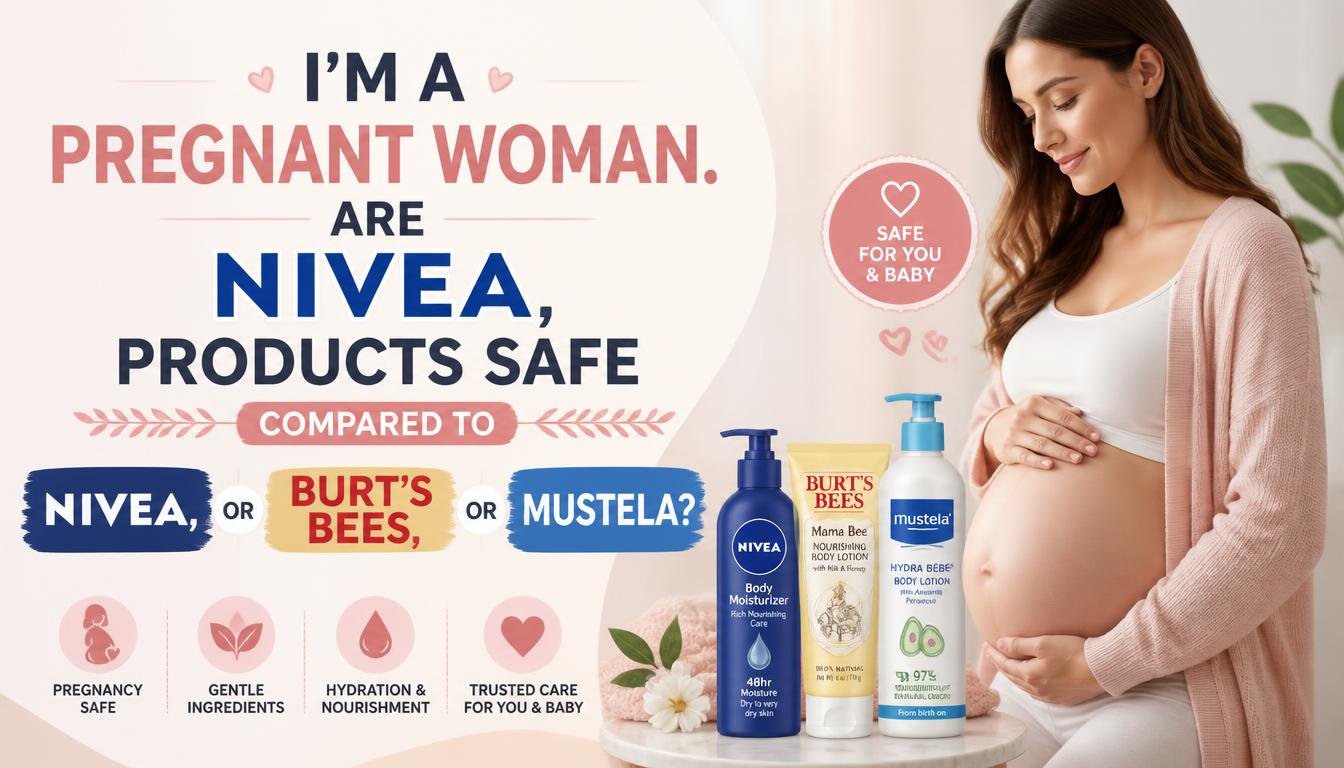
If you are pregnant, it is completely normal to look twice at the skincare products you used without thinking before. A lotion that seemed simple before pregnancy may suddenly make you wonder, “Is this safe for me and my baby?” When you see brands such as Nivea, Burt’s Bees, and Mustela, the choice can become even more confusing because each brand has many different products and different marketing claims.
The short answer is that Nivea products are not automatically unsafe during pregnancy, and Burt’s Bees or Mustela are not automatically safer simply because they may be marketed around natural, maternity, or sensitive-skin care. Nivea says its cosmetic products are evaluated for safety and skin compatibility and are considered safe for pregnant and breastfeeding women. It also advises people with individual concerns to speak with a GP or midwife.
The more useful question is not simply “Which brand is safest?” It is “Is this particular product suitable for pregnancy, and does it fit my skin?” That means checking the ingredient list, product purpose, fragrance, active ingredients, and any allergies or skin conditions you have.
This guide compares Nivea, Burt’s Bees, and Mustela in a practical way. It also explains ingredients worth avoiding or discussing with your healthcare professional, how to choose a moisturizer, and what changes when you are breastfeeding.
1. Are Nivea Products Safe During Pregnancy?
For ordinary cosmetic skincare, Nivea’s official position is reassuring. The company says its cosmetic products undergo safety and skin-compatibility evaluation before being introduced to the market and considers its cosmetic products safe for pregnant and breastfeeding women.
That does not mean every Nivea product should be treated as identical. Nivea makes a very large range of products, including body lotions, creams, face products, cleansers, oils, and other skincare. A basic body moisturizer is very different from a treatment product containing a strong active ingredient.
This is why looking at the individual product is more useful than deciding whether the entire brand is good or bad. If you are buying a simple body lotion for dry skin, your main concerns may be moisturizing ability, fragrance, and personal sensitivity. If you are buying an acne treatment or a product designed to change pigmentation, you need to pay closer attention to its active ingredients.
Nivea also specifically says that its Q10 Firming Body Oil can be used during pregnancy to massage the belly and help keep the skin feeling soft.
What to Check on a Nivea Label
Before adding a new product to your routine, take a minute to check:
- What is the product for? A moisturizer is different from a treatment product.
- What are the active ingredients? This matters especially for acne, pigmentation, or anti-aging products.
- Does it contain fragrance? Fragrance is not automatically a pregnancy danger, but it can bother sensitive skin.
- Do you have known allergies? Avoid ingredients you already know cause a reaction.
- Are you using it on the breast? This deserves extra care if you are breastfeeding.
For example, imagine you already have a Nivea body lotion that you have used for years. If it is a straightforward moisturizer and does not contain an ingredient your healthcare professional has told you to avoid, there may be no reason to panic simply because you are pregnant. On the other hand, if you are starting a new treatment product for acne or pigmentation, it makes sense to check the active ingredients first.
The American Academy of Dermatology recommends checking skincare labels during pregnancy and discussing medications and prescription skincare with your obstetrician or dermatologist.
2. Nivea vs Burt’s Bees vs Mustela: What Is Actually Different?
Nivea, Burt’s Bees, and Mustela can all be useful for skincare, but they have different product ranges and brand positions. Comparing the names alone does not tell you which product is right for you.
Nivea has a broad skincare range for everyday needs. This makes it convenient if you want a familiar body lotion, cream, or other basic moisturizer.
Burt’s Bees places a strong emphasis on ingredients from nature and has a specific Mama Bee range. Its current Mama Bee products include body oil, belly butter, and other products intended for mothers.
Mustela has a particularly strong focus on maternity and baby skincare. Its maternity collection includes products such as multi-purpose lotion, stretch-mark products, and maternity oils.
| What you care about | Nivea | Burt’s Bees | Mustela |
|---|---|---|---|
| Everyday skincare | Strong range | Strong range | Available |
| Pregnancy-focused products | Selected products | Mama Bee range | Strong maternity range |
| Natural-oriented positioning | Not the main focus | Strong focus | Strong natural-origin focus in many products |
| Sensitive-skin options | Product dependent | Product dependent | Product dependent |
| Ingredient checking | Important | Important | Important |
| Best way to compare | Specific formula | Specific formula | Specific formula |
The biggest lesson is simple: do not confuse brand positioning with medical safety.
For example, Burt’s Bees currently lists a Mama Belly Butter with ingredients including sunflower oil, coconut oil, sweet almond oil, shea butter, soybean oil, jojoba butter, cocoa butter, and vitamin E. That product is clearly designed for pregnancy-related body care, but a reader with an allergy to one of its ingredients would still need to avoid it.
Mustela’s maternity products similarly provide pregnancy-specific options. Its Essential Care Multi-purpose Lotion is marketed for pregnancy and postpartum use and is described by the company as compatible with breastfeeding and free of added fragrance.
So, rather than asking which logo should be on your bathroom shelf, ask which formula solves your particular problem with the least unnecessary irritation or concern.
3. Does “Natural” Mean Safer During Pregnancy?
This is one of the biggest misunderstandings in pregnancy skincare.
Seeing the words natural, plant-based, or natural origin may make a product sound automatically safer. But natural does not mean that every person will tolerate every ingredient.
Burt’s Bees openly says that many of its fragrances are natural and are made from blends of essential oils and natural extracts, while some products use partially synthetic fragrances. The company also provides ingredient lists for individual products.
That is actually a useful lesson for shoppers: read the formula rather than relying on the front of the package.
Natural Ingredients Can Still Cause Reactions
Essential oils and plant extracts can be useful cosmetic ingredients, but some people can experience irritation or allergic reactions. Pregnancy can also make your skin feel different from usual.
The American Academy of Dermatology recommends paying attention to ingredients during pregnancy and suggests choosing products free of fragrances and harsh ingredients if irritation is a concern. The AAD also lists certain essential oils among ingredients to use cautiously during pregnancy.
This does not mean every product containing an essential oil is automatically dangerous. It means you should not assume that “natural” removes the need for ingredient awareness.
For example, Burt’s Bees Mama Nourishing Body Oil contains sweet almond oil, lemon oil, and vitamin E. If you enjoy the product and your skin tolerates it, that is one consideration. But someone with a known sensitivity to a particular ingredient may need another option.
Why “Chemical-Free” Is Not a Useful Safety Test
You may see skincare described as “chemical-free.” That phrase should not be your main way of judging a product.
Cosmetic ingredients have chemical names whether they come from plants, minerals, or are made synthetically. What matters more is which ingredients are present, how the product is formulated, how it is used, and whether the ingredients are appropriate for your situation.
A better shopping checklist is:
- Read the full ingredient list.
- Identify active ingredients.
- Check for known allergens.
- Consider fragrance if your skin is sensitive.
- Ask your doctor about unfamiliar treatment ingredients.
- Choose a simple product when you do not need an aggressive treatment.
That approach is much more useful than simply choosing the product with the biggest “natural” label.
4. Which Skincare Ingredients Should Pregnant Women Check?
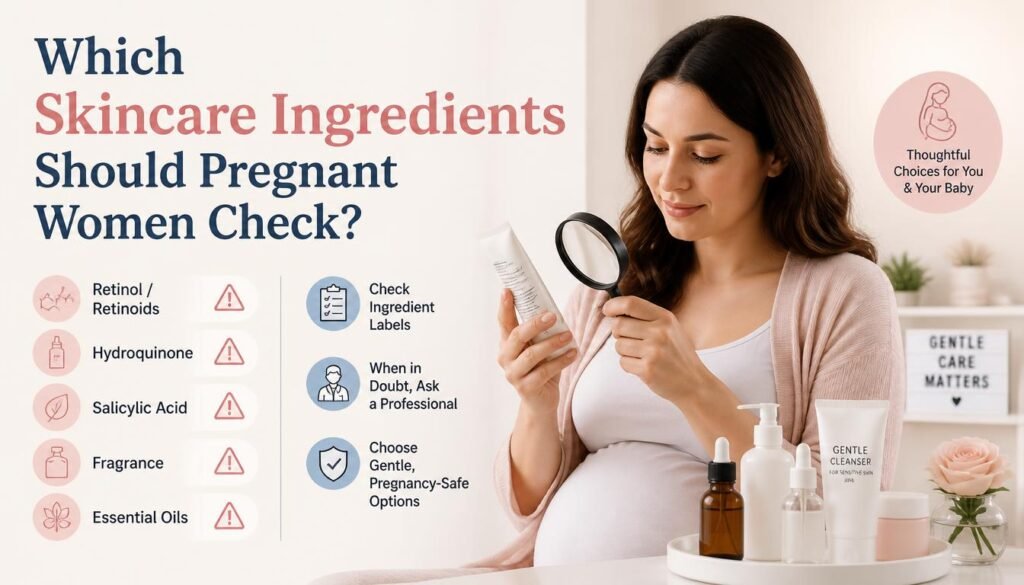
Pregnancy is a good time to review your skincare routine, especially if you use products for acne, wrinkles, pigmentation, or other specific skin problems.
The AAD explains that many skincare products can be used during pregnancy, but certain prescription and over-the-counter ingredients should be avoided or used only with professional guidance.
Ingredients Commonly Avoided During Pregnancy
Some of the most important ingredients to recognize include retinoids and retinol.
Retinoids are commonly found in anti-aging and acne products. They include prescription ingredients such as tretinoin and isotretinoin, as well as retinol-type ingredients in cosmetic products. The AAD states that retinoids should not be used during pregnancy.
The AAD also advises avoiding hydroquinone during pregnancy. It is used as a skin-lightening ingredient and is different from a basic moisturizer.
Other medication ingredients, including some prescription acne or hair-loss treatments, also require medical guidance. This is one reason a pregnancy skincare routine should not be built only from social-media recommendations.
Ingredients That May Need Extra Caution
The situation can be more complicated with ingredients that are sometimes used in lower concentrations or specific circumstances.
The AAD specifically recommends limiting or discussing ingredients such as high-dose salicylic acid, benzoyl peroxide, parabens, phthalates, phenol, triclosan, and certain essential oils with a dermatologist during pregnancy.
This is important because internet advice often turns complicated questions into simple lists of “good” and “bad” ingredients. Real skincare is not always that simple.
For example, a cleanser containing a small amount of an ingredient that is rinsed away is not necessarily comparable to a strong leave-on treatment. Product concentration, frequency, skin area, and intended use can all matter.
Fragrance, Essential Oils and Sensitive Skin
Fragrance deserves a separate discussion because it is often confused with pregnancy safety.
A fragrance may not be the reason a product is unsafe for pregnancy, but it can still be uncomfortable for someone whose skin has become sensitive. Pregnancy can bring dry skin, sensitive skin, acne, melasma, stretch marks, and other changes.
If a scented lotion makes your skin itchy or red, there is little benefit in forcing yourself to continue using it just because the product is popular.
A fragrance-free moisturizer may be a better practical choice for you.
If you develop a significant rash, swelling, burning, or another concerning reaction, stop using the product and seek appropriate medical advice.
5. Which Brand Is Better for Dry, Sensitive or Stretching Skin?
There is no single winner for every pregnant woman.
Your best product depends on what your skin actually needs.
For Dry Skin
Pregnancy can bring dry or sensitive skin, and regular moisturizing can make daily life more comfortable. The AAD recommends a simple routine built around gentle cleansing, moisturizing, and sun protection.
Look for a moisturizer that:
- Feels comfortable on your skin
- Does not cause burning or itching
- Provides enough moisture
- Fits your preferred texture
- Does not contain an ingredient you need to avoid
- Is easy enough to use consistently
Nivea can be a reasonable choice if you prefer its texture and a particular formula suits your skin. Burt’s Bees also has fragrance-free sensitive-skin products. For example, its Hydrating Face & Body Cream is marketed as fragrance-free and designed for sensitive skin.
Mustela also has pregnancy-focused moisturizing products, including maternity lotions designed around changing skin needs.
For Sensitive Skin
If your skin is reactive, the simplest formula may be the best formula.
Do not assume that a long ingredient list is better. If your skin is already irritated, introducing several new products at once makes it harder to know what caused the problem.
Try this approach:
Morning: gentle cleanser if needed → moisturizer → pregnancy-appropriate sunscreen.
Evening: gentle cleanser → moisturizer.
You may not need a separate serum, scrub, oil, toner, mask, and exfoliant just because you are pregnant.
The AAD recommends a simple routine and specifically suggests checking ingredients and considering fragrance-free products when trying to reduce irritation.
If you have eczema or dermatitis, it is especially important to distinguish general cosmetic advice from treatment. A dermatologist can help identify the cause and recommend an appropriate eczema treatment.
For Pregnancy Bumps and Stretch Marks
As your abdomen grows, skin can feel tight, dry, or itchy. Moisturizing may make the skin feel more comfortable.
Nivea says its Q10 Firming Body Oil can be used to massage the belly during pregnancy.
Burt’s Bees has Mama Belly Butter and Mama Nourishing Body Oil specifically designed for pregnancy-related body care.
Mustela has a dedicated maternity collection with products such as stretch-mark cream and stretch-mark oil.
But be careful with expectations. A stretch-mark cream can moisturize and soften the skin, but you should not assume that any cream can guarantee that stretch marks will never appear. Genetics, skin stretching, hormones, and other factors all play a role.
A good practical goal is comfortable, well-moisturized skin, not perfection.
6. How to Choose a Pregnancy-Friendly Skincare Product
If you are standing in a store comparing three bottles, use a simple process instead of guessing.
Step 1 — Identify Your Skin Problem
First ask yourself what you are actually trying to solve.
Is your problem:
- Dry skin?
- Tight belly skin?
- Itching?
- Sensitive skin?
- Acne?
- Pigmentation?
- Stretch marks?
- General daily moisturizing?
If you only need a moisturizer, there is usually no reason to choose a product loaded with strong treatment ingredients.
Step 2 — Read the Ingredient List
Turn the package around.
Look for the full ingredient list and pay particular attention to active ingredients if the product makes treatment claims.
If you are uncertain about a particular ingredient, write down the product name and ingredient list and ask your OB-GYN, midwife, pharmacist, or dermatologist.
This is much safer than relying on a random online comment saying, “I used it during pregnancy and it was fine.”
Step 3 — Consider Fragrance and Allergies
If you normally react to perfume, essential oils, or certain plant extracts, pregnancy is not the time to ignore that history.
A product can be completely acceptable for another person and still be wrong for you.
For example, a pregnant woman with very reactive skin may prefer a fragrance-free body cream. Another woman with normal skin may prefer a lightly scented lotion and have no problems with it.
Your skin’s response matters.
Step 4 — Test the Product Carefully
When trying a new cosmetic, do not introduce five new products on the same day.
Try one new product at a time. If your skin becomes irritated, you will have a better idea of what caused it.
A small patch test can also be useful for people who are prone to reactions, although a patch test cannot guarantee that a product will never cause a reaction later.
Nivea itself notes that individual sensitivity can still lead to allergic reactions even when products have undergone skin-compatibility testing.
Step 5 — Ask a Healthcare Professional When Needed
You do not need to call your doctor every time you buy ordinary hand cream.
But professional advice is sensible if:
- You are using prescription skincare.
- You are treating significant acne.
- You have severe eczema or dermatitis.
- You have a known allergy.
- You are unsure about a strong active ingredient.
- You are treating pigmentation with medication.
- You developed a serious skin reaction.
- You are unsure whether an existing treatment should continue during pregnancy.
The AAD recommends telling your obstetrician and dermatologist about prescription skincare and medications during pregnancy.
7. What About Nivea, Burt’s Bees or Mustela While Breastfeeding?
Breastfeeding adds a slightly different concern because the baby can come into direct contact with products applied around the breast.
Nivea advises that if a cosmetic product is being used on the breast area, it should not be applied immediately before breastfeeding. The company recommends applying it after breastfeeding to help avoid the baby taking up the cosmetic product orally.
Burt’s Bees gives product-specific instructions too. Its Mama Belly Butter says to wipe it off the breasts before nursing, while its Mama Soothing Nipple Cream is specifically marketed as needing no removal before breastfeeding.
Mustela also has products specifically designed around maternity and breastfeeding. Its current Essential Care Multi-purpose Lotion is described as compatible with breastfeeding.
The lesson is important: do not assume that every product from a pregnancy-friendly brand is suitable for use directly on the nipple or breast immediately before feeding.
Always follow the directions for the exact product.
For products used elsewhere on the body, the situation is different because the baby is not directly consuming the product. Still, ingredient and irritation checks remain useful.
5 FAQs
1. Are Nivea products safe during pregnancy?
Nivea states that its cosmetic products are evaluated for safety and are considered safe for pregnant women. Check the specific product formula, especially for active treatments.
2. Is Burt’s Bees safe to use during pregnancy?
Many Burt’s Bees products are designed for everyday and maternity skincare, but natural ingredients are not automatically suitable for everyone. Check the individual ingredients and your allergies.
3. Is Mustela better than Nivea during pregnancy?
Not necessarily. Mustela has a strong maternity skincare range, while Nivea offers a much broader everyday skincare range. The best choice depends on the specific product and your skin needs.
4. Can I use Nivea lotion while pregnant?
Many ordinary moisturizing lotions can be appropriate during pregnancy. Check the exact ingredient list and ask your healthcare professional about products containing active treatment ingredients.
5. What skincare ingredients should I avoid during pregnancy?
Retinoids and hydroquinone are among the ingredients the American Academy of Dermatology recommends avoiding during pregnancy. Other active ingredients may require professional guidance.
Conclusion
So, “I’m a pregnant woman. Are Nivea products safe compared to Burt’s Bees or Mustela?” is not really a question with one brand-level winner.
Nivea states that its cosmetic products are considered safe for pregnant and breastfeeding women. Burt’s Bees offers a Mama Bee range with pregnancy-focused products and emphasizes ingredients from nature. Mustela has a dedicated maternity skincare collection designed around pregnancy and postpartum needs.
The smarter way to choose is to look beyond the logo. Check the individual product, ingredients, fragrance, your skin type, allergies, and what you are actually trying to treat. A simple moisturizer may be all you need for dry skin, while acne, pigmentation, eczema, or other medical concerns may require professional guidance.
Most importantly, do not let marketing terms such as “natural,” “clean,” or “chemical-free” make the decision for you. During pregnancy, ingredient awareness is more useful than brand loyalty. And if you are unsure about an active ingredient or treatment, your OB-GYN, midwife, pharmacist, or dermatologist can help you choose an option that fits your specific situation.