
Introduction
College life can make acne harder to manage. Between classes, exams, late nights, stress, changing routines, and a limited budget, skincare can easily become an afterthought. At the same time, having frequent breakouts can make a student want to find a routine that is simple, affordable, and actually worth following.
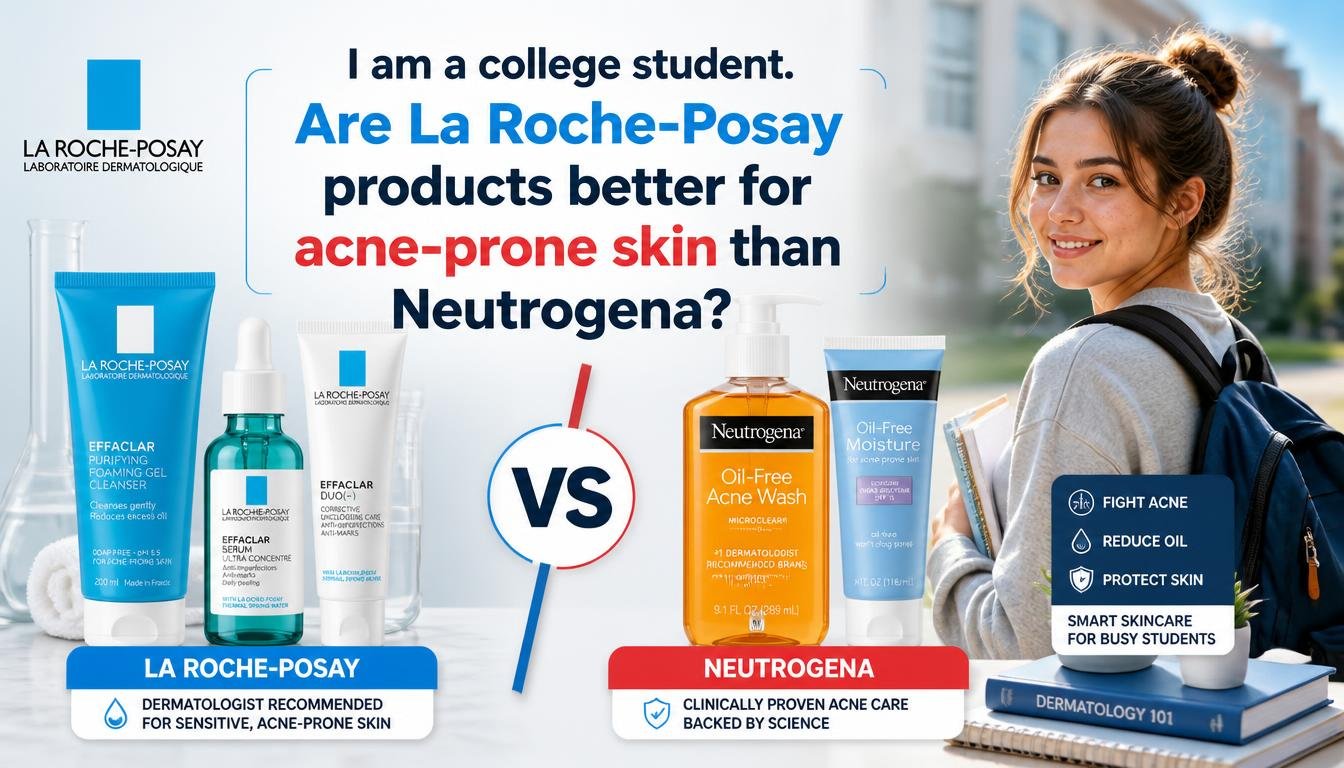
That leads to a common question: I am a college student. Are La Roche-Posay products better for acne-prone skin than Neutrogena?
The short answer is: not necessarily. Neither brand is automatically better for every person with acne. The better choice depends on the product, its active ingredients, skin type, acne concerns, tolerance, and budget.
Both brands have dedicated acne products. La Roche-Posay’s Effaclar range includes products with ingredients such as salicylic acid and benzoyl peroxide, while Neutrogena currently offers a broad acne range containing salicylic acid, benzoyl peroxide, and adapalene products.
For a college student, the smartest approach is not to choose a brand simply because it is popular. Instead, look at what the product is designed to treat, which active ingredient it contains, how your skin reacts to it, and whether you can afford to use it consistently.
This guide compares La Roche-Posay and Neutrogena in practical terms so students can make a more informed choice without building an unnecessarily complicated skincare routine.
La Roche-Posay vs. Neutrogena: Which Brand Is Better for Acne?
La Roche-Posay and Neutrogena take somewhat different approaches to skincare, but there is plenty of overlap in their acne-focused products.
La Roche-Posay’s Effaclar line is specifically positioned around acne-prone and oily skin. Its current U.S. range includes salicylic-acid treatments, a salicylic-acid medicated face wash, and a 5.5% micronized benzoyl peroxide treatment.
Neutrogena also has a large acne selection. Its current acne category includes products containing salicylic acid and benzoyl peroxide, as well as a 0.1% adapalene gel treatment.
So the comparison is not really:
“Which brand is good and which brand is bad?”
It is more useful to ask:
“Which specific product fits this student’s skin and acne?”
For example, a student with mostly blackheads and clogged pores may benefit from a salicylic-acid product. Someone dealing with red, inflamed pimples may need a benzoyl peroxide product. A student with persistent acne may need to consider adapalene or professional treatment rather than simply buying another cleanser.
The American Academy of Dermatology includes benzoyl peroxide, topical retinoids, salicylic acid, and azelaic acid among recommended acne therapies.
Why the Active Ingredient Matters More Than the Brand
This is one of the most important lessons for anyone shopping for acne products.
Suppose two products cost different amounts but contain the same type of acne-fighting ingredient. The more expensive product is not automatically going to work better for a particular person.
Look at the Drug Facts label and active ingredient before buying.
For example:
- Salicylic acid can help unclog pores and is particularly useful for blackheads and whiteheads.
- Benzoyl peroxide is commonly used for inflammatory acne and helps reduce acne-causing bacteria.
- Adapalene is a topical retinoid that helps keep pores from becoming clogged and reduces inflammation.
The AAD notes that salicylic acid works by unclogging pores, while benzoyl peroxide is particularly useful for mild pimples. It also recommends starting benzoyl peroxide at a lower strength, such as 2.5%, to reduce the risk of irritation.
That means a student should choose based on the acne problem first and the brand second.
7 Key Differences Between La Roche-Posay and Neutrogena for Acne-Prone Skin

1. Acne-Fighting Ingredients
The first difference to examine is the actual acne treatment inside the product.
Salicylic Acid
Salicylic acid is a beta hydroxy acid that helps loosen material inside clogged pores. It can be especially useful when acne looks like:
- Blackheads
- Whiteheads
- Small clogged pores
- Oily or congested skin
La Roche-Posay currently has Effaclar products featuring 0.5% salicylic acid, including a multi-target acne treatment.
Neutrogena also has numerous salicylic-acid products. Its current acne range includes cleansers and other treatments using salicylic acid in different formulations.
For a college student with mostly clogged pores, either brand could make sense. The important thing is choosing a formulation that the skin can tolerate.
Benzoyl Peroxide
Benzoyl peroxide is another established acne ingredient.
It is often a better fit when the main concern is red, inflamed pimples rather than simply clogged pores.
La Roche-Posay currently sells Effaclar BPO Multi-Target Acne Treatment containing 5.5% micronized benzoyl peroxide.
Neutrogena offers several benzoyl peroxide products as well. Its Stubborn Acne AM Treatment contains 2.5% benzoyl peroxide, while its Rapid Clear Stubborn Acne Spot Gel contains 10%.
This is a good example of why simply asking which brand is better can be misleading.
A student might prefer the Neutrogena 2.5% option if starting with benzoyl peroxide and wanting a lower concentration. Another person might have a different recommendation from a dermatologist.
Retinoids
Retinoids are another important acne treatment category.
Neutrogena currently lists a 0.1% adapalene gel among its acne products.
Adapalene can be useful for recurring acne because it works differently from ingredients that simply exfoliate the skin or kill acne-causing bacteria. The AAD strongly recommends topical retinoids as part of evidence-based acne treatment.
If acne is persistent, a student should not assume that adding more cleansers or spot treatments is the answer. A dermatologist or other qualified healthcare professional can help determine whether a retinoid or another treatment makes sense.
2. Sensitive-Skin Considerations
A student with acne may also have sensitive skin. That creates a tricky situation: acne treatments can help breakouts, but some can also cause dryness, peeling, redness, or irritation.
This is why a strong acne product is not always the best product.
La Roche-Posay’s Effaclar BPO treatment, for example, is currently described by the brand as suitable for sensitive skin and fragrance-free. The company also advises starting benzoyl peroxide once daily because excessive drying can occur.
Neutrogena also has acne products with sensitive-skin considerations. Its Stubborn Acne AM Treatment is listed as fragrance-free and warns that irritation and dryness can occur with benzoyl peroxide.
The practical lesson is simple:
Do not judge a product only by how powerful it sounds. Judge it by how your skin handles it.
If a treatment leaves the face constantly burning, peeling, or painfully dry, using more of it is not a better strategy.
A simple check can help:
- Introduce one new acne treatment at a time.
- Follow the product directions.
- Start less frequently if the product directions or a healthcare professional recommend doing so.
- Watch for persistent irritation.
- Keep the rest of the routine gentle.
- Use moisturizer consistently.
3. Product Variety
Both brands offer more than just one acne cleanser.
La Roche-Posay’s Effaclar collection currently includes acne treatments, cleansers, toners, and moisturizers designed around acne-prone or oily skin.
Neutrogena has an even broader current acne category, with products including cleansers, moisturizers, treatments, blemish patches, salicylic-acid products, benzoyl peroxide products, and adapalene.
That variety can be helpful, but it can also create a problem for college students: too many choices.
A student might see:
- Acne cleanser
- Acne toner
- Acne serum
- Spot treatment
- Exfoliant
- Mask
- Acne moisturizer
- Acne patches
and think all of them are necessary.
They are not.
A good acne routine can be surprisingly simple.
For many students, the basic structure is:
Morning:
Cleanser → treatment if appropriate → moisturizer → sunscreen
Night:
Cleanser → acne treatment → moisturizer
The exact products depend on the person’s skin and treatment plan.
4. Price and College-Student Budget
This is where Neutrogena may have an advantage for some students, simply because budget matters.
College students often have to balance skincare against:
- Tuition
- Books
- Transportation
- Food
- Rent
- Phone bills
- Social activities
A skincare routine that costs a large amount every month may be difficult to maintain.
Current U.S. product listings show that La Roche-Posay’s Effaclar products can reach higher price points. For example, its Effaclar BPO treatment is currently listed at $24.99 for 20 mL and $39.99 for 40 mL, while its medicated acne face wash is listed at $18.99.
That does not mean the products are poor value. It simply means a student should consider the total routine cost.
Neutrogena has multiple acne options and products at different price points.
A Better Way to Compare Cost
Instead of asking:
“Which brand is cheaper?”
Ask:
“How much will my complete routine cost, and can I keep buying it?”
For example, a student may be better off spending money on:
- One effective acne treatment
- One gentle cleanser
- One moisturizer
- One sunscreen
rather than buying six different treatments.
Consistency is more useful than having an expensive bathroom shelf.
5. Oily vs. Dry Acne-Prone Skin
Not all acne-prone skin behaves the same way.
Oily Skin
Students with oily skin may notice:
- Shine during the day
- Greasy T-zone
- Enlarged-looking pores
- Frequent blackheads
- Clogged pores
A salicylic-acid product may be useful because it helps exfoliate inside pores. La Roche-Posay’s Effaclar salicylic-acid treatment is specifically positioned for acne-prone and oily skin.
But oily skin still needs moisture.
Removing too much oil can leave the skin feeling tight and irritated, which can make a routine harder to tolerate.
Dry Acne-Prone Skin
Dry skin needs a different approach.
If the face becomes flaky after acne treatment, adding more strong products may make the problem worse.
A student with dry acne-prone skin should prioritize:
- Gentle cleansing
- A suitable moisturizer
- One acne treatment at a time
- Avoiding unnecessary exfoliation
- Sun protection
Neutrogena also recommends moisturizing as part of an acne routine, noting that even oily skin needs moisture.
Combination Skin
Combination skin can be especially confusing.
For example, the forehead and nose may become oily while the cheeks feel dry.
In that case, the goal is not to aggressively treat the entire face. A student may need a balanced routine that addresses acne while protecting areas that are easily dried out.
6. Post-Acne Marks and Texture
Acne does not always end when a pimple disappears.
A student may be left with:
- Dark spots
- Red-looking marks
- Uneven texture
- Enlarged-looking pores
- New breakouts in the same area
This is why acne prevention and post-acne care can overlap.
La Roche-Posay’s current Effaclar Duo+M product, for example, contains 0.5% salicylic acid and is marketed for acne blemishes as well as post-acne marks. Its formula also includes niacinamide and other ingredients positioned around oil control and skin comfort.
Neutrogena’s Evenly Clear range similarly addresses acne and post-acne marks. Its current product information lists salicylic acid in several products and N-acetyl glucosamine in its gel moisturizer for the appearance of post-acne marks.
However, students should not turn their routine into an aggressive exfoliation project.
If the priority is acne, control the breakouts first. Then build a routine that supports the appearance and overall health of the skin.
7. Ease of Building a Simple Routine
This difference matters more than it sounds.
The best skincare routine for a busy college student is one that the student will actually follow.
A routine that takes 20 minutes and uses eight products may sound impressive, but it is not very practical when someone has an early lecture at 8 a.m.
A better approach is to build around the basics.
Morning
Step 1: Gentle cleanser
Step 2: Acne treatment if appropriate
Step 3: Moisturizer
Step 4: Broad-spectrum sunscreen
Evening
Step 1: Cleanser
Step 2: Acne treatment
Step 3: Moisturizer
If the student is using a stronger treatment, the exact frequency should follow the product directions or professional advice.
The goal is not to use every product from La Roche-Posay or Neutrogena. The goal is to create a routine with a clear purpose for every step.
Which Brand Makes More Sense for Different Acne Concerns?
There is no universal winner, but the following framework makes the decision easier.
| Main concern | What to prioritize |
|---|---|
| Mostly blackheads and whiteheads | Salicylic acid |
| Red, inflamed pimples | Benzoyl peroxide |
| Sensitive skin | Gentle, lower-irritation routine |
| Dry acne-prone skin | Treatment + good moisturizer |
| Oily skin | Pore-clearing treatment + lightweight hydration |
| Tight college budget | Affordable products with appropriate active ingredients |
| Repeated acne | Consistent routine and possibly a retinoid |
| Persistent or severe acne | Dermatologist evaluation |
| Post-acne marks | Acne control plus mark-focused care |
The important point is that the active ingredient should match the problem.
For example, if a student has mostly blackheads, buying a product simply because it is marketed as “maximum strength” may not make sense.
Likewise, if someone has inflamed acne, a basic cosmetic moisturizer alone is unlikely to solve the problem.
How a College Student Can Build an Affordable Acne Routine
The biggest mistake is trying to fix everything at once.
Instead, start with a basic routine and add treatment carefully.
Morning Routine
1. Cleanse gently
Use a cleanser appropriate for the skin type. Avoid aggressive scrubbing.
2. Apply the chosen acne treatment
Use the product according to its directions. If the skin is sensitive, introducing an active treatment gradually can make the routine easier to tolerate.
3. Moisturize
Choose a lightweight moisturizer if the skin is oily, or a more nourishing option if it is dry.
4. Use sunscreen
Sunscreen is particularly important when using acne treatments that can make skin more sensitive or irritated.
Evening Routine
1. Cleanse
Remove sunscreen, makeup, sweat, and everyday buildup.
2. Use the acne treatment
Do not automatically apply multiple acne medications together.
3. Moisturize
This helps support the skin barrier and can make acne treatment easier to tolerate.
What Not to Do
Don’t start five active ingredients at once
If the skin improves, you will not know which product helped.
If the skin becomes irritated, you also will not know which product caused the problem.
Don’t scrub acne aggressively
Acne is not dirt that needs to be scrubbed away.
Harsh physical exfoliation can make an already irritated face feel worse.
Don’t keep increasing the amount
More product does not automatically mean faster results.
For example, Neutrogena’s benzoyl peroxide product specifically warns that excessive drying can occur and advises reducing use if bothersome dryness or peeling develops.
La Roche-Posay provides similar caution for its 5.5% benzoyl peroxide product, advising users to start with one application daily and reduce frequency if dryness or peeling occurs.
Don’t skip moisturizer
Even oily skin can become dehydrated or irritated.
A balanced routine is usually easier to maintain than a routine designed to completely strip away oil.
Don’t change products every few days
Give a sensible acne routine enough time to evaluate unless significant irritation occurs.
Constantly changing products can make it difficult to understand what is actually working.
La Roche-Posay vs. Neutrogena: Which Should a College Student Choose?
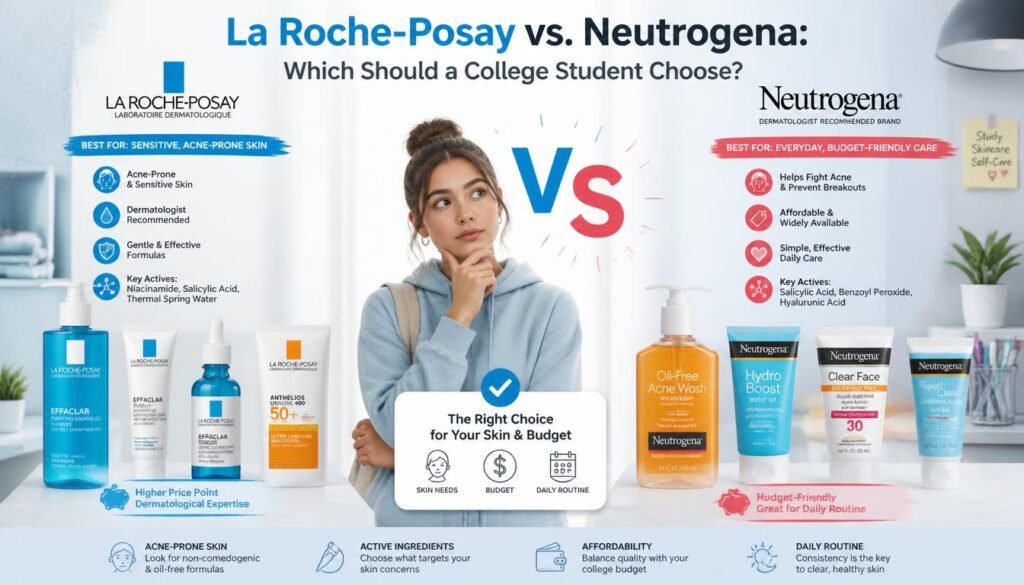
So, which one should a college student buy?
La Roche-Posay may make sense if:
- Sensitive-skin considerations are important.
- The student likes the formulation of a specific Effaclar product.
- The product fits the student’s acne concern.
- The student is comfortable spending more on a particular treatment.
- The student wants a focused acne range.
La Roche-Posay currently has Effaclar products targeting clogged pores, blackheads, whiteheads, blemishes, oily skin, and post-acne marks, depending on the product.
Neutrogena may make sense if:
- Budget is a major consideration.
- The student wants several acne-treatment formats.
- A salicylic-acid, benzoyl-peroxide, or adapalene product matches their needs.
- The student wants to keep the routine simple.
- The products are easier to find or repurchase locally.
Neutrogena’s current acne range includes numerous salicylic-acid products, benzoyl peroxide treatments, and adapalene.
Can You Use Both Brands?
Yes, a skincare routine does not have to be loyal to one brand.
A student could theoretically use a cleanser from one brand, a treatment from another, and a moisturizer from a third brand.
The key is ingredient compatibility and avoiding unnecessary duplication.
For example, using several exfoliating acne treatments at once may increase irritation without providing a clear benefit.
If a student is unsure about combining products, introducing them one at a time is a much safer way to understand how the skin reacts.
When Should Someone With Acne See a Dermatologist?
Over-the-counter products can be useful, but they are not the answer to every acne problem.
Consider professional advice if acne is:
- Painful
- Deep or cystic
- Persistent despite consistent treatment
- Leaving scars
- Getting worse
- Affecting confidence or daily life significantly
- Causing severe irritation from treatment
The American Academy of Dermatology’s acne guidelines include topical treatments such as benzoyl peroxide and retinoids and also cover prescription options for people who need more intensive treatment.
A dermatologist can also help determine whether the problem is ordinary acne or another skin condition that looks similar.
That can save a student months of buying random products.
5 FAQs
1. Is La Roche-Posay better than Neutrogena for acne?
Not necessarily. Both brands offer acne products, and the better choice depends on the active ingredient, skin type, acne concern, and budget.
2. Is Neutrogena good for acne-prone skin?
Yes. Neutrogena offers products containing ingredients such as salicylic acid, benzoyl peroxide, and adapalene for different acne concerns.
3. Is La Roche-Posay good for sensitive acne-prone skin?
Some La Roche-Posay products are designed with sensitive and acne-prone skin in mind, but individual tolerance still matters.
4. Can I use La Roche-Posay and Neutrogena together?
Yes. Products from both brands can be combined when appropriate. Avoid unnecessarily combining multiple strong acne treatments because this may increase irritation.
5. Which is more affordable for college students?
Neutrogena may offer more budget-friendly options, but students should compare the total cost and ingredients of the complete routine rather than choosing based on brand price alone.
Conclusion
For a college student asking, “I am a college student. Are La Roche-Posay products better for acne-prone skin than Neutrogena?”, the most honest answer is that there is no universal winner.
La Roche-Posay has a strong acne-focused Effaclar range, including salicylic-acid and benzoyl-peroxide treatments, and several products designed with acne-prone or sensitive skin in mind.
Neutrogena also offers a broad acne selection, including salicylic acid, benzoyl peroxide, and adapalene products.
For a student, the smarter decision is to work backward from the actual problem.
Have clogged pores? Look at salicylic acid.
Have red, inflamed pimples? Consider benzoyl peroxide.
Have recurring acne? A retinoid such as adapalene may be worth discussing with a healthcare professional.
Have sensitive or dry skin? Focus on a gentle routine and avoid piling on multiple strong actives.
Have a tight budget? Choose products you can realistically repurchase and use consistently.
In other words, don’t choose the brand first—choose the right acne treatment for the skin first. A simple routine with the right ingredients is often a much better starting point than an expensive collection of products.