

Introduction
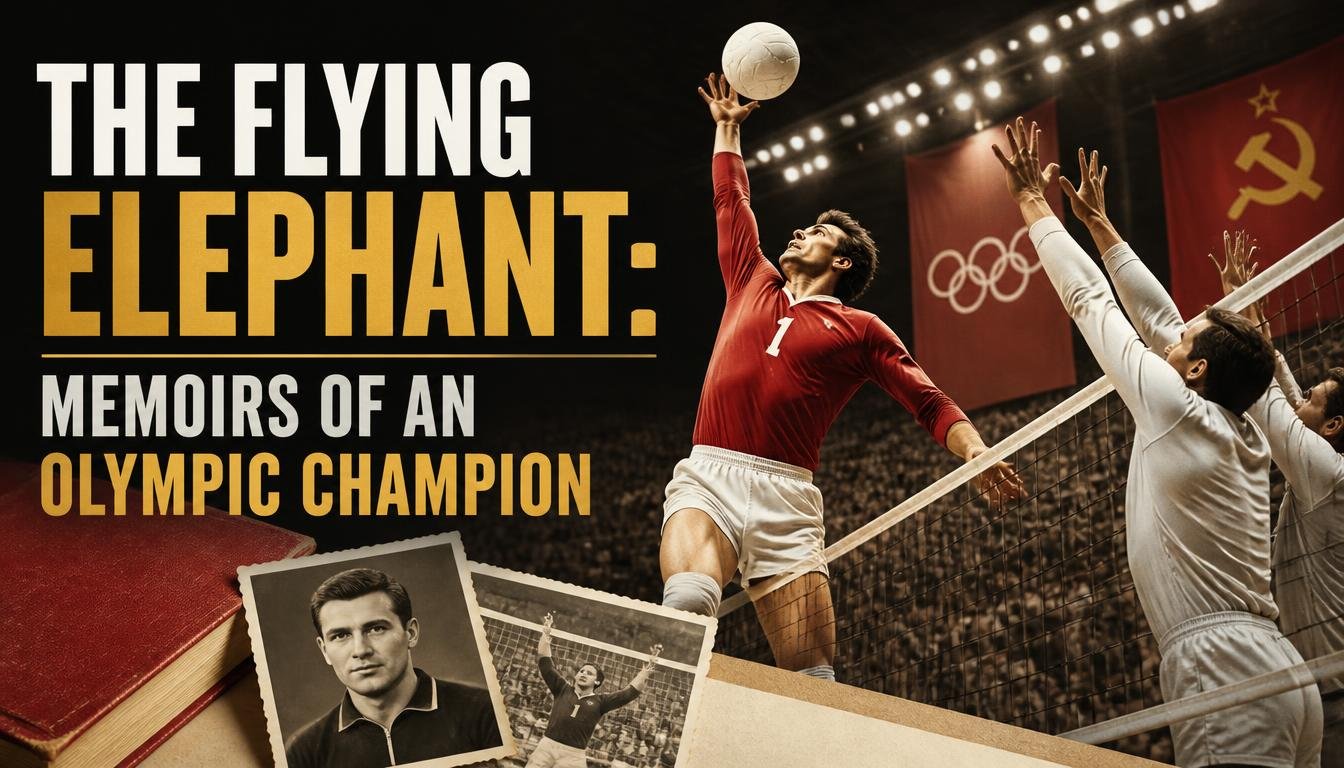
Sports memoirs can do something that a list of medals never can: they can show what life looked like before, between, and behind the biggest victories. The Flying Elephant: Memoirs of an Olympic Champion offers readers that kind of opportunity through the story of Alexander Savin, a celebrated Soviet volleyball player and Olympic champion.
Savin competed at the highest level of international volleyball during a period when the Soviet Union was one of the major forces in the sport. His Olympic record alone makes his career worth studying. He won silver at the 1976 Montreal Olympics and then helped the Soviet team win gold at the 1980 Moscow Olympics.
But an Olympic medal does not explain an athlete’s entire journey.
Behind every championship are years of training, coaching, competition, teamwork, mistakes, pressure, and difficult decisions. That is where a memoir becomes especially valuable. Instead of looking at Savin only as an Olympic champion, readers can use his story to understand the person and athlete behind those achievements.
For volleyball fans, the book offers a connection to an important period in volleyball history. For sports biography readers, it provides another example of how ambition and discipline develop over time. And for people simply interested in remarkable human stories, Savin’s career raises a question that applies far beyond sport: What does it really take to perform when the pressure is at its highest?
This guide explains what readers should know about The Flying Elephant, who Alexander Savin is, why his Olympic journey matters, and what useful lessons can be taken from the story.
What Is The Flying Elephant: Memoirs of an Olympic Champion?
The Flying Elephant: Memoirs of an Olympic Champion is a sports memoir centered on Alexander Savin’s volleyball career and experiences in elite international sport. Current book listings identify Savin as the author, with Andrei Savine credited as translator and Julia Savine as editor on the English edition.
The book is particularly interesting because it gives readers access to the perspective of someone who actually experienced the sporting world being described. That makes it different from a biography written entirely by an outside researcher.
A conventional biography might explain an athlete’s career by looking at statistics, interviews, newspaper reports, tournament results, and historical records. A memoir can add another layer: how the athlete remembers those experiences.
That difference matters.
A match result can tell readers who won. A memoir can help readers think about what it felt like to prepare for the match, live with expectations, work with teammates, and deal with the consequences afterward.
Available descriptions of the English edition also highlight extensive photographic material, with listings describing more than 240 photographs connected with volleyball history, competitions, training, and personal archives.
Why the Title “The Flying Elephant” Stands Out
The title is unusual enough to make a reader stop.
An elephant is normally associated with size, strength, and weight. Flying suggests movement, freedom, and something that appears impossible. That contrast naturally fits the broader idea of athletic achievement: an athlete can begin with limitations, uncertainty, or a difficult challenge and eventually reach a level that once seemed unrealistic.
However, readers should be careful about treating every symbolic interpretation found online as an official explanation from Savin. Unless the author directly explains the title in the book or an authoritative interview, it is better to view the symbolism as an interpretation rather than a confirmed fact.
That is also a useful lesson when researching sports books online. A memorable phrase can generate many explanations, but the strongest article separates documented information from interpretation.
Who Is Alexander Savin?
Alexander Savin is a former Soviet volleyball player whose career reached the highest level of international competition. He represented the Soviet Union and became an Olympic champion at the 1980 Moscow Games after previously earning an Olympic silver medal at Montreal in 1976.
He is particularly associated with the middle-blocker position, an important role in volleyball that demands timing, anticipation, jumping ability, and strong defensive reading at the net. Contemporary descriptions of his career also connect him with CSKA Moscow and the Soviet national team.
For readers who are unfamiliar with volleyball, the middle blocker has to make fast decisions. The player watches the opposing attack, tracks the setter and hitters, and tries to form an effective block while also being ready to contribute offensively.
That means elite performance is not simply about being tall or able to jump high. It requires anticipation and coordination.
Savin’s career is therefore useful as an example of how an athlete develops several skills at once. Physical ability may open the door, but training, coaching, tactical awareness, and teamwork help an athlete remain competitive at the international level.
From Athlete to Olympic Champion
The path from promising athlete to Olympic champion is rarely a straight line.
Young athletes often start with ambition. They may dream about championships before they fully understand what championship-level competition demands. As the level rises, the difference between athletes becomes smaller. Everyone is talented. Everyone trains. Everyone wants to win.
At that point, details matter.
A better reaction, cleaner technique, smarter decision, stronger recovery, or more disciplined preparation can make the difference between a good performance and an exceptional one.
That is one reason sports memoirs are valuable. They remind readers that achievement is usually the result of many small actions rather than one dramatic moment.
Savin’s story can be viewed through that lens. His Olympic medals were highly visible accomplishments, but they represented only the final stage of a much longer athletic development.
Alexander Savin’s Olympic Journey and Biggest Achievements
Savin’s Olympic story contains an important contrast: silver in 1976 and gold in 1980.
He was part of the Soviet team that won silver at the Montreal Olympics in 1976 and then became an Olympic champion at the Moscow Games in 1980.
That progression gives readers an especially useful way to understand competitive sport.
Winning silver is already an extraordinary achievement. Yet athletes often experience medals differently from spectators. A silver medal can represent an incredible accomplishment while still leaving the athlete thinking about the match that was lost and what could have been done differently.
Four years later, the opportunity to compete again created a new chapter.
The 1976 Olympic Experience
The 1976 Montreal Games were an important part of Savin’s Olympic career because the Soviet team reached the podium but finished with silver.
For a general reader, the important point is not simply the medal color. It is what second place can teach about competition.
There is a common assumption that athletes are either winners or losers. Real sporting careers are more complicated.
An athlete can:
- Achieve something extraordinary and still feel disappointed.
- Learn more from a loss than from an easy victory.
- Use an unsuccessful result to identify weaknesses.
- Carry experience from one tournament into the next.
- Become more prepared for future pressure.
That is why adversity can be an important part of an athlete’s development.
A championship career is not necessarily built by avoiding disappointment. Often, it develops through learning how to respond to it.
The 1980 Olympic Breakthrough
The 1980 Moscow Olympics brought a different result for Savin and the Soviet team: gold.
That victory transformed the Olympic story from one of reaching the podium to one of becoming champion.
The context also makes the achievement historically interesting. Savin’s career took place during the Cold War, when international sport often carried significance beyond the competition itself.
For athletes representing the Soviet Union, major international events were part of a larger sporting system and national culture. That historical background helps modern readers understand why memoirs from that era can be valuable.
Statistics tell us that a team won gold.
Personal accounts can help readers understand what it meant to live through the preparation and competition surrounding that achievement.
What Readers Can Learn From Savin’s Memoir
A good sports memoir should offer more than inspiration.
The most useful question is: What can a reader take away from the athlete’s experience?
Savin’s career provides several practical lessons that can apply to athletes, coaches, students, professionals, and anyone working toward a difficult goal.
1. Achievement Is Built Before the Big Moment
Olympic competition lasts only a short time compared with the years required to prepare for it.
That principle applies almost everywhere.
Someone preparing for an examination does not become ready on exam morning. A business does not become successful because of one good meeting. A volleyball player does not become an Olympic athlete because of one excellent match.
The real work happens beforehand.
A useful way to apply this lesson is to break a large goal into repeatable actions:
- Identify the main skill.
- Practice it regularly.
- Measure progress.
- Correct mistakes.
- Repeat.
- Increase the difficulty gradually.
- Review performance after important tests.
This approach turns ambition into something practical.
2. Adversity Can Become Useful Information
The 1976 silver medal provides an obvious example of how competition can contain both achievement and disappointment.
A setback does not automatically make someone stronger. The useful part comes from what happens afterward.
Instead of asking only, “Why did I lose?” a better question is:
“What does this result tell me that I did not know before?”
For an athlete, the answer might involve technique, communication, preparation, fitness, or mental pressure.
For a student, it might reveal weak study habits.
For a professional, it might expose a communication problem.
The lesson is simple: disappointment becomes useful when it is converted into information.
3. Teamwork Matters as Much as Individual Talent
Volleyball is fundamentally a team sport.
A player can make an outstanding block, attack, serve, or defensive play, but the team still depends on communication and coordinated movement.
That makes Savin’s career particularly relevant to readers interested in leadership and coaching.
In high-level competition, teammates need to trust each other. Players must understand their roles and communicate quickly. Coaches must create systems that allow individual talent to work together.
This is a broader lesson about achievement: individual ability becomes more powerful when it fits into a strong team structure.
4. Coaching Can Change an Athlete’s Development
Great athletes do not develop in isolation.
Coaching can provide technical knowledge, discipline, feedback, tactical preparation, and emotional support. A good coach also recognizes that different athletes may require different approaches.
For readers involved in sports, one practical takeaway is to treat feedback as a tool rather than a personal attack.
After a performance, ask:
- What worked?
- What failed?
- What should be repeated?
- What should change?
- What can be practiced before the next competition?
That simple review process can turn experience into improvement.
5. Success Does Not End the Story
An Olympic medal can become the defining achievement of an athlete’s public identity.
But a person is more than a medal.
This is one reason memoirs can be more interesting than a basic career summary. They can explore the period before success, the experience of success, and life beyond competition.
Savin’s story also connects with coaching and the broader world of volleyball after playing. That makes the career more complete than a simple list of Olympic results.
Soviet Volleyball, Coaching, and the World Behind the Medals
To understand Savin’s career properly, readers should consider the sporting environment in which he competed.
Soviet volleyball was part of a highly organized sports culture. Savin’s association with CSKA Moscow and the Soviet national team placed him inside a system designed to develop athletes for major national and international competition.
Modern readers may be tempted to look only at the final results. But the more interesting question is how an athlete reaches that level.
Training systems can influence:
- Technical development
- Physical preparation
- Tactical understanding
- Team discipline
- Competition experience
- Coaching relationships
- Mental preparation
The historical context is also important because Savin competed during the Cold War. International sporting events sometimes carried political and cultural importance that went beyond the scoreboard.
That does not mean every match should be reduced to politics. Volleyball remained a sport played by athletes who had to perform specific technical skills under pressure.
But understanding the period helps readers appreciate the environment surrounding those performances.
Why This Historical Context Matters
Sports history can disappear quickly when only results are recorded.
A table may show that a team won gold.
It cannot fully show:
- How athletes trained.
- What their relationships were like.
- How competition felt from inside the team.
- What coaches demanded.
- What players feared.
- How athletes responded to pressure.
- What everyday life around major tournaments looked like.
This is where memoirs have historical value.
They preserve personal perspectives that may not appear in official records.
Readers should still compare memoirs with independent historical sources when researching specific facts. A memoir is a personal account, and memory can be selective. That does not make it unimportant; it simply means it should be read as both history and personal testimony.
What Makes The Flying Elephant Different From a Typical Sports Biography?
A typical sports biography may be organized around major dates: birth, childhood, professional debut, major championships, Olympic appearances, retirement, and later career.
A memoir can work differently.
It gives the athlete an opportunity to describe events from a personal point of view.
That can make seemingly ordinary moments more meaningful.
A championship match may receive only a few lines in a statistical record. For the athlete involved, however, it may represent months of preparation, relationships with teammates, difficult travel, coaching decisions, pressure, and memories that lasted for decades.
That personal perspective is the major reason readers may choose a memoir over a conventional biography.
The English edition is also presented as a substantial book, with current listings describing a Kindle edition of 514 pages and extensive photographic material.
Why Photographs and Archives Add Value
Photographs can be especially useful in sports history.
A modern reader may know the names of Olympic champions without knowing what their teams looked like, how uniforms and venues changed, or what sporting culture looked like during a particular period.
Archival photographs can provide that visual context.
They can also help readers connect names with faces and understand that sports history is made up of real people rather than statistics.
For a memoir about a historical volleyball career, that can make the reading experience more personal.
Who Is Most Likely to Enjoy the Book?
The memoir is a natural fit for:
Volleyball fans:
Readers interested in the history of elite volleyball can explore an important period through an athlete’s perspective.
Olympic-history readers:
Anyone interested in the people behind Olympic results may find Savin’s career especially relevant.
Sports biography readers:
Readers who enjoy stories about ambition, adversity, achievement, and competition can approach the book as a human story rather than only a volleyball book.
Coaches and athletes:
The themes of preparation, teamwork, leadership, and performance can provide ideas for reflection.
Readers interested in Soviet sports history:
The memoir offers a personal route into a sporting system that shaped many successful athletes.
If someone is completely unfamiliar with volleyball, it may help to learn the basic rules and positions first. That is not required, but it can make descriptions of tactics and player roles easier to understand.
How to Read The Flying Elephant for More Than Entertainment
Readers can get more from a sports memoir by treating it as a learning resource.
Instead of simply moving from page one to the final page, keep a few questions in mind.
A Simple Five-Question Reading Check
While reading, ask:
- What challenge is Savin facing here?
- What decision does he make?
- What role do teammates or coaches play?
- What changes after the experience?
- What lesson could apply outside volleyball?
This method turns a sports biography into a practical study of performance and decision-making.
For example, if the memoir describes a difficult period of training, do not focus only on the difficulty. Look for the system that helped the athlete continue.
If it describes a major victory, ask what happened before the victory.
If it describes a disappointing result, look for how the athlete responded.
That is often where the most useful lessons are found.
5 FAQs
1. What is The Flying Elephant: Memoirs of an Olympic Champion about?
It is a sports memoir focused on Alexander Savin, his volleyball career, Olympic experiences, and journey through elite Soviet-era competition.
2. Who is Alexander Savin?
Alexander Savin is a former Soviet volleyball player and Olympic champion who won silver in 1976 and gold in 1980.
3. What Olympic medals did Alexander Savin win?
Savin won an Olympic silver medal at the 1976 Montreal Games and Olympic gold at the 1980 Moscow Games.
4. Is The Flying Elephant a memoir or autobiography?
It is presented as a memoir/autobiographical work centered on Savin’s own sporting experiences and career.
5. Who should read The Flying Elephant?
It is especially suitable for volleyball fans, Olympic-history readers, sports-biography enthusiasts, athletes, coaches, and readers interested in Soviet sports history.
Conclusion
The Flying Elephant: Memoirs of an Olympic Champion is interesting because Alexander Savin’s story can be viewed from several angles at once.
It is the story of an Olympic volleyball champion. It is also a story about preparation, competition, coaching, teamwork, ambition, and the pressure that comes with elite sport.
Savin’s Olympic record gives the memoir a strong foundation: silver at Montreal in 1976 followed by gold at Moscow in 1980. But reducing his career to those two medals would miss much of what makes the story worth exploring.
The more valuable lesson is what sits between the results.
Elite achievement takes years. Setbacks can become learning opportunities. Coaching can influence development. Teams can turn individual ability into collective performance. And success does not necessarily mark the end of an athlete’s story.
For volleyball fans, the memoir provides a personal connection to an important era of the sport. For Olympic-history readers, it offers another way to look beyond medal tables. And for anyone interested in sports biographies, Savin’s journey demonstrates why the human story behind an achievement can be just as important as the achievement itself.
That is ultimately what makes The Flying Elephant worth considering: it invites readers to look beyond the podium and ask what it actually takes to get there.