

Introduction
You were scrolling your phone, checking email, or just browsing the web when it happened — a message popped up mentioning globalunpaid com. Maybe it landed in your inbox. Maybe it showed up as a notification on your lock screen. And your first thought was probably something like: “Do I owe money? Is this a scam? Why is this happening to me?”
Take a breath. You’re not alone in searching for answers, and the situation is a lot less scary than it sounds.
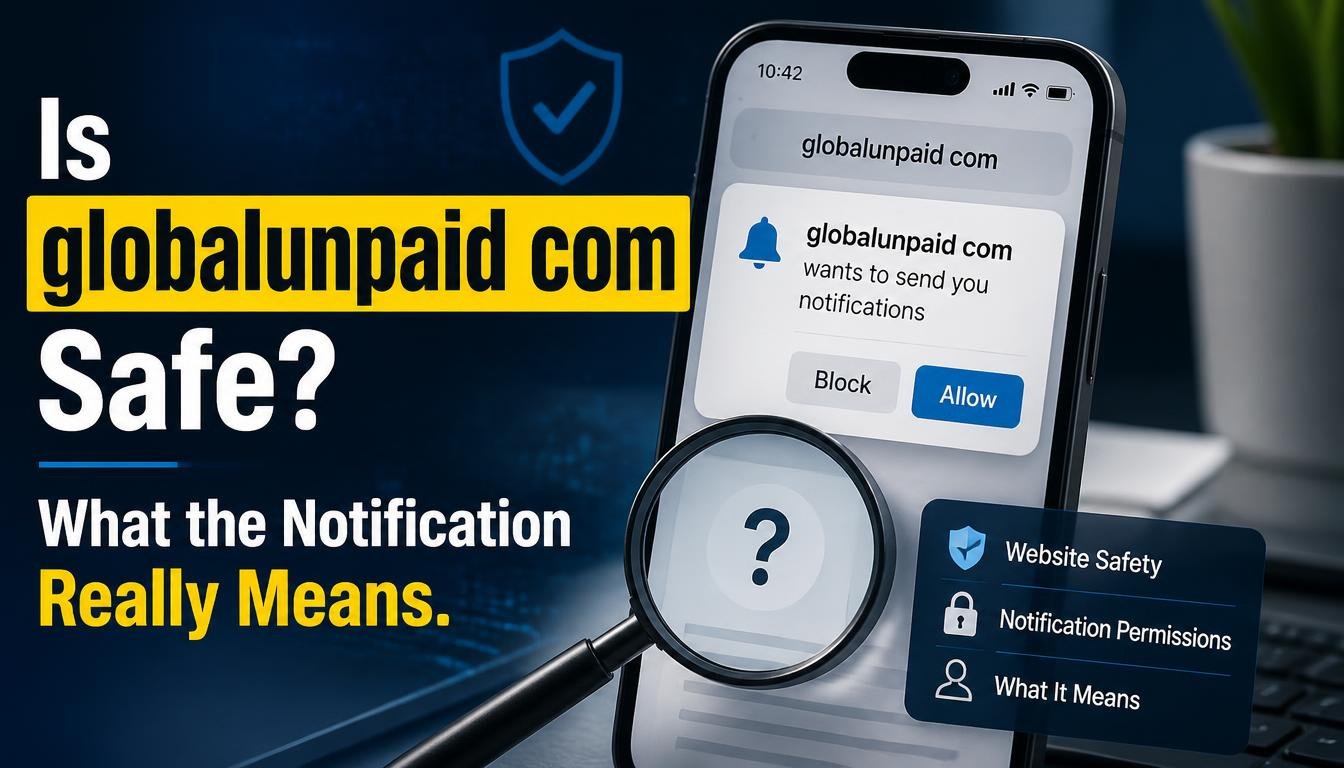
Here’s the short version: GlobalUnpaid.com is a content publishing website, not a debt collection agency, and it’s not sending you a bill. What you likely received is a browser notification — the kind that gets set up when you (or someone using your device) clicked “Allow” on a pop-up at some point, maybe without even realizing it.
But “it’s probably fine” isn’t a satisfying answer on its own. You deserve to understand exactly what’s going on, why it happened, and how to make it stop. That’s what this guide is for. We’ll walk through what the site actually is, why you’re seeing these alerts, how to tell it apart from a real scam, and the exact steps to turn the notifications off for good. We’ll also show you how to check the safety of any unfamiliar website yourself, so you’re not left guessing next time something like this pops up.
What Is GlobalUnpaid.com, Exactly?
Despite the name, GlobalUnpaid.com is not a debt recovery service, a government agency, or a financial institution. It’s a general content website — the kind that publishes articles across a wide mix of topics like technology, finance, business, health, travel, and lifestyle. Think of it as an online magazine rather than anything tied to money you personally owe.
The site has been active for a couple of years and runs on a fairly standard content platform setup. It publishes new articles regularly, and like a lot of general-interest blogs, it covers whatever topics seem to be getting attention at the time. There’s nothing inherently unusual about that structure — plenty of legitimate websites operate the exact same way, covering a wide range of subjects instead of sticking to one niche.
If you want to verify any of this yourself instead of just taking an article’s word for it, that’s a good habit to build. A quick WHOIS lookup (a free tool that shows when a domain was registered and by roughly how long it’s been active) can confirm how old a site is. Domain age alone doesn’t prove a site is trustworthy, but a site that’s been consistently active for a couple of years with regular content is a different story than a domain that appeared last week.
Why the Name Sounds Like a Debt Collector
Let’s address the elephant in the room: the name “GlobalUnpaid” does sound like it belongs to a collections agency chasing you for money. That’s almost certainly a branding choice — maybe an attempt to stand out, maybe just an available domain name — rather than a sign of what the site actually does.
This kind of naming mismatch happens more often than you’d think online. A site’s name doesn’t have to describe its content. You’ve probably come across plenty of businesses and websites whose names don’t quite match what they do. In this case, the name creates unnecessary alarm for people who stumble onto it without context, which is exactly why so many people end up searching “is globalunpaid com a scam” in the first place.
Why Did You Get a Notification From It?
So if the site itself isn’t a debt collector, why did it end up on your screen in the first place? That’s the real question — and this is usually the part that confuses people the most, because many readers don’t remember ever visiting the site, let alone signing up for anything from it. The explanation almost always comes down to one thing: browser push notifications.
Here’s how it typically works. Many websites — not just this one — show a small pop-up when you first visit, asking something like “Would you like to receive notifications?” If you click “Allow,” even by accident or without reading it carefully, your browser starts sending you alerts from that site directly to your desktop or phone, even when you’re not actively on the page.
A realistic example: Imagine you clicked a link from social media or a search result, landed on an article on GlobalUnpaid.com, and a notification permission pop-up appeared at the top of your browser. You were mid-scroll, trying to close what looked like an ad or a distraction, and you tapped “Allow” without registering what it was for. Weeks later, a notification shows up referencing globalunpaid com, and you have no memory of ever agreeing to it. This is incredibly common — it’s not a sign that anything sinister happened, just that browser permission pop-ups are easy to click through without noticing.
It’s also worth mentioning that this can happen on shared or family devices. If someone else used your phone, tablet, or computer to browse the web and accidentally allowed notifications, you’d see the alerts too, even though you personally never visited the site. That mismatch — “I never went to this site, why am I getting messages from it?” — is one of the most common reasons people get alarmed by browser notifications in general.
Is GlobalUnpaid.com a Scam?
From everything that can be checked independently, there’s no strong evidence that GlobalUnpaid.com is a phishing operation or a scam designed to steal money or personal information. It functions like a real content website: it publishes articles, it’s been active for a while, and it doesn’t appear to be demanding payment or personal details through its notifications.
That said, a fair answer needs a caveat: being a legitimate content site doesn’t mean every single ad, pop-up, or third-party link that appears on it is automatically safe. Many content sites, including well-established ones, run ads through third-party networks, and occasionally a bad actor slips a malicious ad into that system. This isn’t unique to GlobalUnpaid.com — it’s a general risk of ad-supported websites. The smart move is general caution, not blanket trust or blanket fear.
Where this gets genuinely important is telling the difference between an annoying browser notification and an actual scam attempt. Let’s put them side by side.
How This Differs From a Real Debt Collection Notice
A real debt collection notice, or a genuine scam trying to impersonate one, usually has some very specific traits:
- It references an actual account, loan, or creditor you can identify — not a vague, unnamed debt
- It comes through verified channels — physical mail, a known collections agency, or an email from a domain that matches a real company you’ve dealt with
- It includes specific case or reference numbers tied to a real account
- It often uses urgent, threatening language — “act now,” “legal action pending,” “account will be frozen”
- It asks you to provide sensitive information — bank details, Social Security or National Insurance numbers, ID scans — or to pay immediately through unusual methods like gift cards, wire transfers, or crypto
A GlobalUnpaid.com browser notification, by contrast, is typically a short, generic message pointing to an article or headline on the site — not a personalized demand for money, and not a request for your bank details. If what you received actually matches the red flags above — urgent payment demands, requests for sensitive personal information, unfamiliar case numbers — treat that as a serious warning sign regardless of which website or sender name is attached to it, and don’t provide any information until you’ve verified it independently.
How to Stop GlobalUnpaid.com Notifications
If the notifications are annoying you, the good news is that turning them off takes about two minutes, and the steps are similar across most browsers and devices.
On Chrome (Desktop & Android)
- Open Chrome and click the three-dot menu in the top right corner
- Go to Settings > Privacy and security > Site settings
- Scroll down and tap Notifications
- Find globalunpaid.com in the list of sites
- Tap it and select Block, or tap the three dots next to it and choose Remove
On Android, the path is nearly identical: open Chrome, tap the three dots, go to Settings > Notifications > Site settings, find the site, and block it.
On Safari (Mac & iPhone)
On Mac:
- Open Safari and go to Safari > Settings (or Preferences on older versions)
- Click the Websites tab
- Select Notifications from the sidebar
- Find globalunpaid.com and change the setting to Deny, or remove it from the list
On iPhone:
- Open Settings and scroll down to Notifications
- Scroll through the list of apps and sites for an entry mentioning the site, or one listed under Safari
- Tap it and turn Allow Notifications off
- If nothing shows up there, open Safari, visit the site, tap the “aA” icon in the address bar, choose Website Settings, and turn off notifications directly from that menu
On Edge and Firefox
Edge: Click the three dots in the top right, go to Settings > Cookies and site permissions > Notifications, find the site, and block or remove it.
Firefox: Click the menu button, go to Settings > Privacy & Security, scroll to Permissions, click Settings next to Notifications, find the site, and remove or block the permission.
Once you’ve blocked it, the notifications should stop immediately. If you’re still seeing them after following these steps, double-check that you blocked the exact right entry — sometimes similar-looking site names or subdomains can cause confusion.
How to Check If Any Unfamiliar Site Is Safe (Not Just This One)
Rather than relying on any single article to reassure you, it’s worth learning a quick habit you can use whenever an unfamiliar website name catches you off guard. Here’s a simple checklist:
- Check the domain age. Free WHOIS lookup tools will show you when a domain was registered. A site that’s existed for a couple of years with consistent activity is generally lower risk than a domain registered days ago.
- Look for the SSL certificate. Check that the site’s address starts with “https” and shows a padlock icon in your browser bar. This confirms the connection is encrypted, though keep in mind it doesn’t guarantee the content itself is trustworthy — plenty of scam sites also use SSL now.
- Run it through Google Safe Browsing or VirusTotal. Paste the site’s web address into Google’s Safe Browsing status checker or into VirusTotal.com — both are free and scan the URL against databases of known malicious sites in seconds. A clean result isn’t a 100% guarantee, but a flagged result is a clear signal to stay away.
- Ask yourself the gut-check questions. Is it asking for payment upfront? Does it use urgent or threatening language? Does the actual web address match what it claims to be, with no odd spelling or extra characters? If you answer yes to any of these, slow down and verify independently before doing anything else.
This kind of quick check takes less than five minutes and works for any unfamiliar site, not just this one — worth bookmarking for the next time something unexpected pops up.
What to Do If You Already Clicked a Link or Entered Info
If you’re reading this after already interacting with a GlobalUnpaid.com notification, here’s how to think about your next steps based on what you actually did.
If you just clicked the notification and landed on an article, but didn’t enter any information: the risk here is very low. Simply follow the steps above to block future notifications, and there’s nothing further you need to do.
If you entered personal or financial information — like an email address, password, or payment details — on a page after clicking through, take these steps:
- Change the password for any account where you reused that same password
- Keep an eye on your bank and card statements for the next few weeks for anything unfamiliar
- Consider setting up a fraud alert with your bank if you shared financial details
- Turn on two-factor authentication on your important accounts if you haven’t already
If you believe you’ve been targeted by an actual scam rather than just an unwanted notification — for example, you were asked for payment, ID documents, or bank details under pressure — report it. In the UK, you can report to Action Fraud. In the US, the FTC (reportfraud.ftc.gov) handles these reports. Reporting doesn’t just protect you; it helps flag patterns that protect other people too.
Conclusion
If there’s one thing to take away from all this, it’s that a strange-sounding notification doesn’t automatically mean you’re in financial trouble. The name feels alarming, but what’s actually behind it is a routine content website and a browser permission you can switch off in a couple of clicks — not a bill, and not anyone coming after you for money.
Two things are worth holding onto beyond this specific situation. First, you now know exactly how to stop these kinds of notifications for good, on whatever browser or device you use. Second, you have a quick, repeatable way to check whether any unfamiliar website is worth your trust — domain age, SSL, a safe browsing check, and a gut check on red flags like urgency and payment requests. The next time an unexpected name pops up on your screen, you won’t need to panic or search for answers from scratch — you’ll already know what to do.
5 FAQ Questions
1. Is GlobalUnpaid.com safe or a scam?
GlobalUnpaid.com appears to operate as a general content website rather than a debt collection agency. Still, verify unfamiliar links before interacting with them.
2. Why am I getting GlobalUnpaid.com notifications?
You may have allowed browser notifications from the site, possibly accidentally or while using a shared device.
3. How do I stop GlobalUnpaid.com notifications?
Open your browser’s notification or site-permission settings, find GlobalUnpaid.com, and select Block, Remove, or Deny.
4. Can a GlobalUnpaid.com notification infect my device?
Simply receiving a notification does not normally infect your device. The greater risk comes from clicking suspicious links or submitting personal information.
5. What should I do if I clicked a GlobalUnpaid.com link?
If you only viewed an article, there may be little cause for concern. If you entered sensitive information, change reused passwords and monitor relevant accounts.