

Introduction
Finding the best time to post on TikTok can feel confusing. One study may recommend afternoon posts, while another may show strong results in the evening or even early morning. The reason is simple: TikTok does not have one magic posting hour that works for every creator, influencer, brand, or audience.
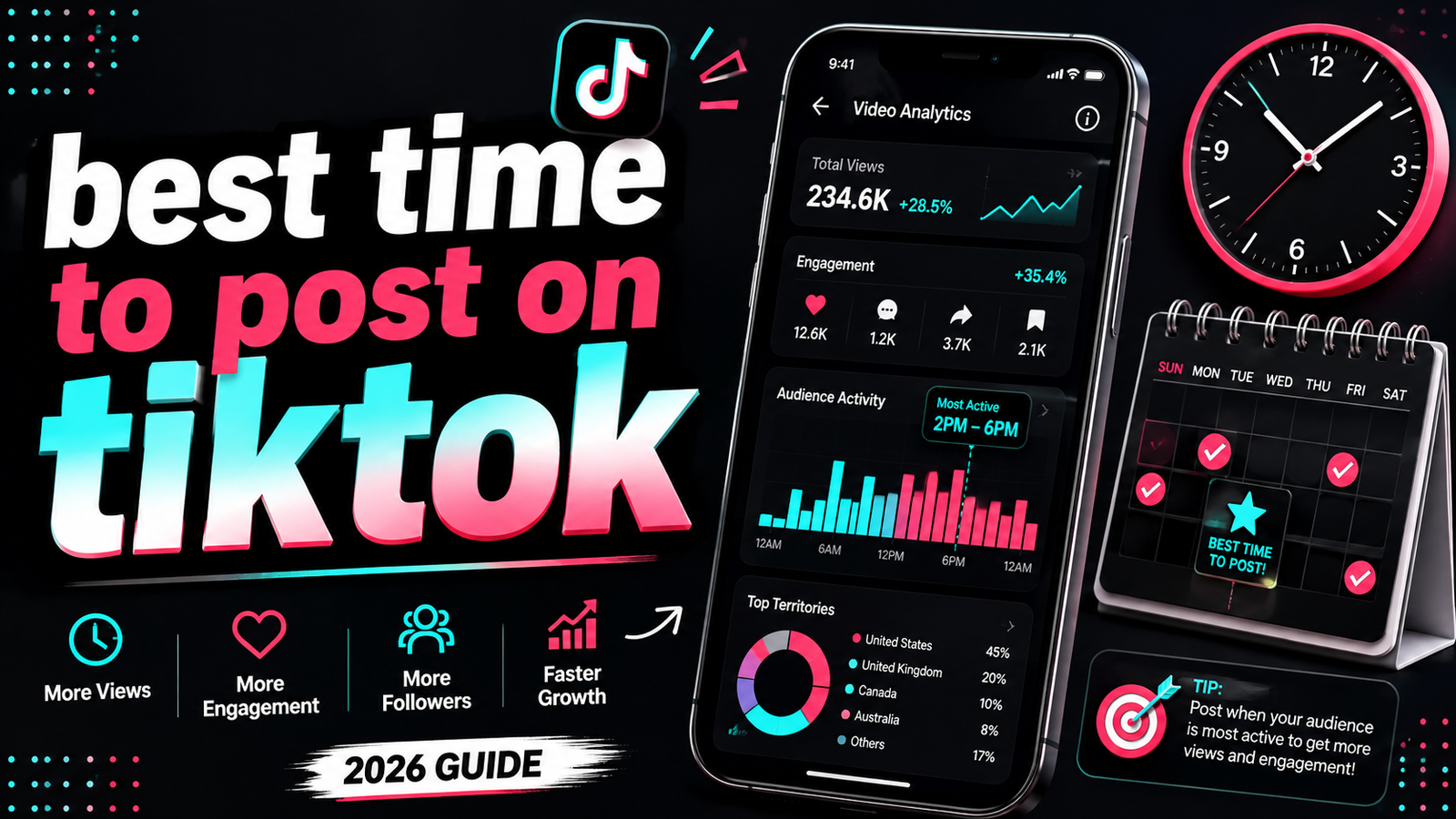
Current research shows this clearly. Sprout Social’s 2026 analysis found strong TikTok engagement during weekday afternoons, especially Tuesday through Thursday from 2 p.m. to 6 p.m. local time. However, other large datasets have found different high-performing windows. These differences are a good reminder that general studies are useful starting points, but personal audience data is more valuable.
The right approach is to use general posting windows as a test, then check when a specific audience is active. TikTok provides analytics and audience information that can help creators understand views, engagement, follower growth, and other performance signals.
This guide explains the strongest times to test, how posting time can affect early engagement, how to adjust for different audiences and time zones, and how to build a posting schedule based on real results instead of guesswork.
What Is the Best Time to Post on TikTok?
There is no single best time that guarantees high views. However, several useful time windows can be tested when an account does not yet have enough historical data.
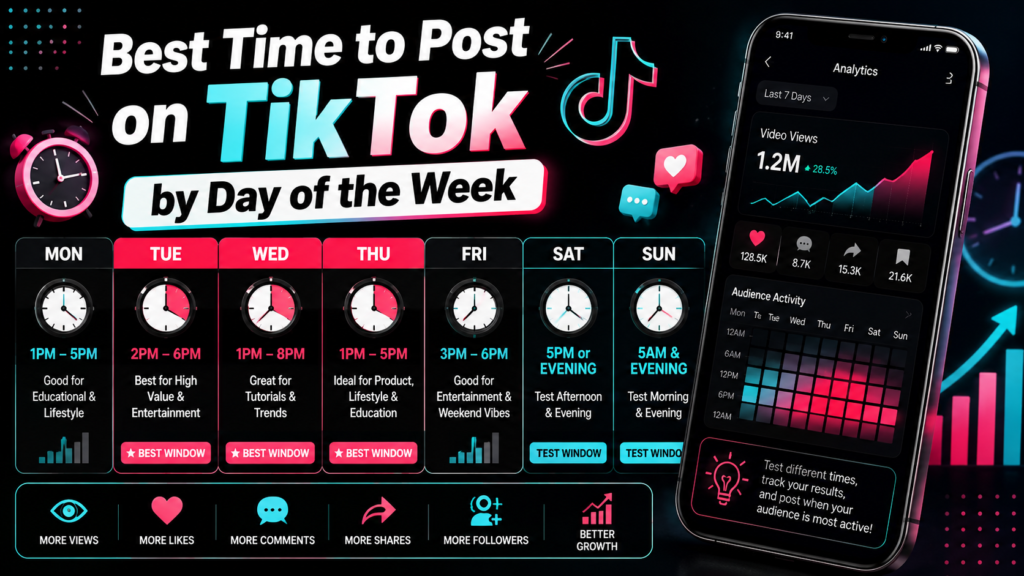
For a general starting point, weekday afternoons are worth testing first. Sprout Social’s 2026 research identifies Tuesday through Thursday, 2 p.m. to 6 p.m. local time, as a particularly strong overall window. Its day-level data also shows Monday around 3–5 p.m., Tuesday around 2–6 p.m., Wednesday around 1–8 p.m., Thursday around 1–5 p.m., and Friday around 3–5 p.m.
That does not mean a video posted at 4 p.m. will automatically outperform one posted at 8 p.m. TikTok performance depends on many factors. TikTok itself explains that recommendations can involve user interactions, video information such as captions, sounds and hashtags, and other account or device signals.
A simple starting schedule could look like this:
| Day | Starting window to test |
|---|---|
| Monday | 3–5 p.m. |
| Tuesday | 2–6 p.m. |
| Wednesday | 1–6 p.m. |
| Thursday | 1–5 p.m. |
| Friday | 3–6 p.m. |
| Saturday | Test morning and evening |
| Sunday | Test morning and evening |
These are test windows, not promises. The best schedule for a gaming creator, beauty influencer, restaurant brand, or B2B company may look completely different.
The most important question is not simply, “When are TikTok users online?” It is, “When is the target audience most likely to watch and interact with this type of content?”
That difference can make a big impact.
For example, a fitness creator may have followers who scroll before work and after dinner. A business creator may have more professional viewers during lunch or after working hours. A student-focused account may perform better when school or college is finished.
Therefore, use broad recommendations to create your first testing schedule. Then let account-specific data take over.
Best Time to Post on TikTok by Day of the Week
A day-by-day schedule makes testing easier because audience behavior can change throughout the week.
Monday
Monday can be a useful day for afternoon posting. A starting window around 3–5 p.m. gives creators a chance to reach people during afternoon breaks and later-day scrolling.
For example, a productivity creator could publish a short “3 ways to have a better Monday” video in the afternoon. A food creator might post a quick dinner idea before people start thinking about their evening meal.
The important point is to match the content with the moment. A serious educational video may not fit the same audience mood as a funny entertainment video.
Tuesday
Tuesday is one of the strongest days to test. Current 2026 research places Tuesday’s useful window around 2–6 p.m. local time.
Creators can use Tuesday to test educational content, product demonstrations, tutorials, entertainment clips, or trend-based videos.
If an account usually posts at night, Tuesday afternoon can also provide a useful comparison. The goal is not to immediately change the entire content strategy. It is to collect enough comparable results to see whether the new window produces better performance.
Wednesday
Wednesday provides another strong testing opportunity. A practical starting range is 1–6 p.m., although broader research can show useful engagement outside that range.
This is a good day to compare content performance against Tuesday. For example, a creator could publish similar educational videos on Tuesday and Wednesday while keeping the topic, video length, and format reasonably consistent.
That makes the timing comparison more useful.
Thursday
Thursday is another strong weekday to test. Sprout Social’s current data places Thursday around 1–5 p.m.
Thursday can also work well for content connected to the upcoming weekend. Travel accounts might share weekend trip ideas. Restaurants might promote weekend specials. Fashion creators could publish outfit ideas.
The content should naturally fit the audience’s mindset rather than simply being posted because a chart says Thursday is good.
Friday
Friday is worth testing in the afternoon, particularly around 3–5 p.m. in the cited 2026 dataset.
However, Friday audience behavior can vary widely. Some people are busy finishing work or school. Others may begin their weekend scrolling earlier.
Entertainment, lifestyle, food, travel, shopping, and event-related content may have strong reasons to test Friday.
Saturday
Saturday should not automatically be ignored. Some studies produce different results for weekends, which shows why creators should check their own audience rather than blindly following a universal weekday rule.
Test at least one morning and one evening slot if Saturday is important to the target audience.
For example, a fitness account might test Saturday morning when people are planning workouts. A food account could test late afternoon when people begin thinking about dinner.
Sunday
Sunday can also be useful, especially for lifestyle, planning, entertainment, family, food, and educational content.
Instead of assuming Sunday is either “good” or “bad,” test it against weekdays. If Sunday produces strong watch time and shares, there is no reason to stop using it simply because another study ranks weekdays higher.
The key lesson is simple: a general study describes a large group of accounts; analytics describe the behavior around a specific account.
Best Time to Post on TikTok in the Morning, Afternoon, and Evening
Time of day matters because people use TikTok differently depending on what they are doing.
Morning Posting
Morning posts can work when the target audience is active before work, school, or other daily activities.
A morning strategy may suit:
- Motivational content
- Fitness routines
- News or updates
- Quick educational tips
- Morning routines
- Food and breakfast ideas
- Short entertainment
The mistake is assuming that every audience behaves the same way.
A creator targeting office workers might test 7–9 a.m. A student-focused creator might find that later morning or afternoon works better.
Morning testing is particularly useful when an account has followers spread across different locations. A post published in the creator’s morning may actually reach an important audience segment during its evening.
Afternoon Posting
Afternoon is one of the most useful periods to test for many TikTok accounts.
Current 2026 research from Sprout Social identifies weekday afternoons as a particularly strong overall window, with Tuesday through Thursday between 2 p.m. and 6 p.m. standing out in its dataset.
Afternoon users may be taking lunch breaks, finishing school, taking work breaks, or simply looking for entertainment.
A creator can test several smaller windows rather than treating the entire afternoon as one period.
For example:
- Test 1: 1–2 p.m.
- Test 2: 3–4 p.m.
- Test 3: 5–6 p.m.
After several posts, compare the results.
Evening Posting
Evening can be valuable because people often have more free time after work or school.
Entertainment, gaming, fashion, beauty, food, lifestyle, and creator-led content can all be worth testing during evening hours.
TikTok’s own organic playbook has also historically emphasized evening as a high-engagement period, while recommending that quality take priority over simply increasing posting volume.
The best way to test evening is to compare it against afternoon posts rather than assuming one is always better.
For example, a creator could publish similar videos on Tuesday at 3 p.m. and Thursday at 8 p.m. If the evening video receives better watch time and shares, that is useful evidence for that particular account.
How to Find Your Personal Best Time to Post on TikTok
Generic studies are useful when an account is new, but analytics become more valuable as content history grows.
TikTok’s analytics tools are designed to help creators understand content performance, audience growth, views, likes, comments, shares, and video-level performance. TikTok has also explained that video analytics can show information such as total views and average watch time.
A simple testing process can help turn that information into a practical posting schedule.
Step 1: Identify the Main Audience
First, determine who the content is actually trying to reach.
Look at:
- Audience location
- Age group
- Follower behavior
- Main interests
- Content preferences
- Local time zones
- When followers are most likely to be available
For business accounts, TikTok’s Business Suite provides analytics and audience information, while Audience Insights can provide aggregated information about audience demographics, location, interests, behaviors, and activity.
Step 2: Choose Two or Three Time Windows
Do not test ten different times at once.
Choose two or three practical windows.
For example:
Test A: 2 p.m.
Test B: 5 p.m.
Test C: 8 p.m.
Use these times consistently for several posts.
Step 3: Keep the Content Similar
This is one of the most important parts of the test.
Suppose a creator posts:
- A 20-second tutorial at 2 p.m.
- A 60-second story at 5 p.m.
- A funny meme at 8 p.m.
It becomes difficult to know whether timing or content caused the performance difference.
Instead, compare similar content formats whenever possible.
Step 4: Record the Results
Create a simple spreadsheet with columns such as:
| Date | Time | Topic | Views | Watch Time | Shares | Comments | Followers |
|---|
After several weeks, patterns may become easier to see.
Step 5: Look Beyond Views
Views are useful, but they should not be the only metric.
TikTok itself recommends looking at the bigger picture rather than treating one engagement metric as the most important measure for every video.
Compare:
- Watch time
- Retention
- Likes
- Comments
- Shares
- Saves, where available
- Engagement rate
- Profile visits
- Follower growth
- Website clicks or conversions for brands
A video with 20,000 views and strong conversions may be more valuable to a business than a video with 50,000 views and almost no action.
Step 6: Repeat the Test
Do not choose a permanent posting time after one successful video.
One video can perform unusually well because of the topic, trend, hook, sound, or audience response.
Instead, look for repeated patterns.
If five afternoon posts consistently outperform five evening posts on similar content, the evidence becomes much stronger.
Best TikTok Posting Times for Creators, Influencers, and Brands
Different users have different goals, so they should not all follow the same schedule.
Creators
Creators should focus heavily on follower activity and content performance.
For example, a cooking creator might discover that followers are most active in the late afternoon. A gaming creator might find stronger results in the evening.
The best schedule is the one that fits the audience and the creator’s ability to publish consistently.
Influencers
Influencers should think about both engagement and campaign goals.
Suppose an influencer is promoting a skincare product. Posting when followers are active can help generate initial attention, but the campaign should also track clicks, product interest, comments, and conversions.
A sponsored post should not be judged only by raw views.
Brands
Brands have an additional layer to consider: customer behavior.
A restaurant might test content before lunch or dinner. A clothing brand might test around shopping periods. A software company might find that its audience behaves differently from a consumer entertainment account.
TikTok’s Business Account tools include analytics, creative resources, scheduling features, and other business-focused capabilities.
Global Audiences
Global accounts face a different challenge.
Imagine a creator has:
- 40% of followers in the United States
- 25% in the United Kingdom
- 20% in Australia
- 15% across other countries
There may be no single hour that is perfect for everyone.
In this situation, the creator can either choose the time that best serves the largest audience segment or create different publishing windows for important regions.
The first step is knowing where the audience is located.
Does Posting Time Really Affect TikTok Views and Engagement?
Yes, timing can matter, but it is only one part of the picture.
Posting when the target audience is active can increase the chance that people see and interact with the content soon after publication. That can make timing useful as part of a broader content strategy.
But timing does not replace good content.
TikTok says its recommendation system considers signals such as user interactions, video information, and other factors. It also notes that stronger indicators of interest, such as completing a video, can carry more weight than weaker signals.
This means a creator should not think:
“I posted at the perfect time, so the video must go viral.”
A better way to think about it is:
“I posted when my audience was likely to be available, and now the content itself needs to earn attention.”
The first few seconds matter. The topic matters. The hook matters. The format matters. Viewer retention matters. Shares and comments matter. Audience relevance matters.
TikTok’s own business guidance also emphasizes tracking performance and improving content based on what works.
So timing should support a strong content strategy rather than become the entire strategy.
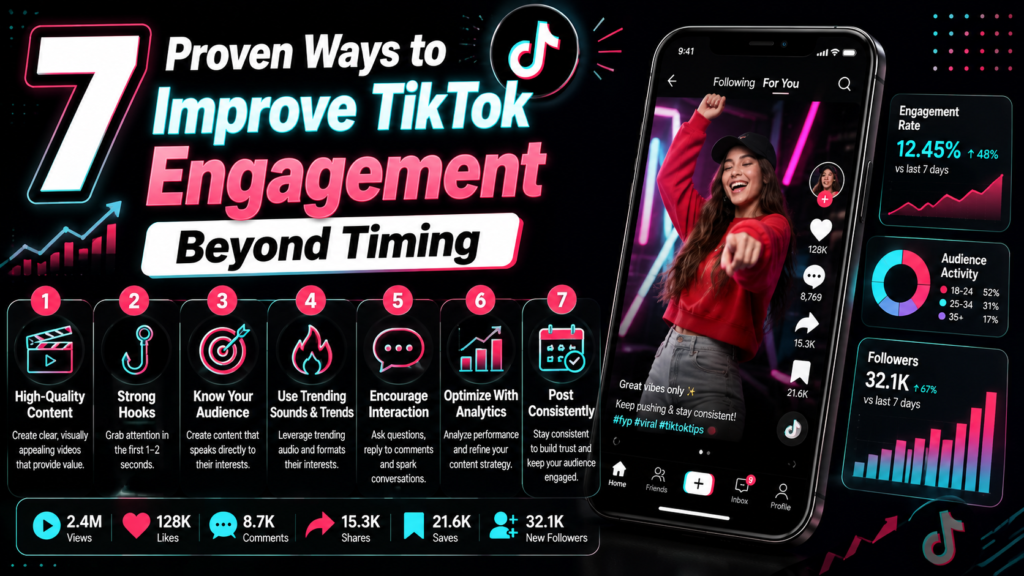
7 Proven Ways to Improve TikTok Engagement Beyond Timing
Test Different Posting Times
The easiest way to improve timing is to test it.
Choose two or three windows and compare similar content over several weeks.
Avoid changing the time every day without recording results. Random posting makes it difficult to learn anything.
A simple test could be:
- Week 1: Tuesday at 3 p.m.
- Week 1: Thursday at 3 p.m.
- Week 2: Tuesday at 6 p.m.
- Week 2: Thursday at 6 p.m.
Continue the process and compare performance.
Improve the First Few Seconds
A good posting time cannot rescue a weak opening.
The first seconds should make the viewer understand why the video is worth watching.
Instead of starting with a long introduction, try:
- A useful question
- A surprising fact
- A clear problem
- A quick result
- A strong visual
- A direct promise
For example, instead of:
“Today I want to talk about three ways to save money…”
Try:
“Stop making these three money mistakes.”
The second opening creates a stronger reason to continue watching.
Create Content for the Target Audience
Knowing when people are online is not enough.
The content must also match what they want.
A beauty audience may respond to tutorials and product comparisons. A fitness audience may want quick workouts. A business audience may prefer practical strategies and examples.
TikTok’s Audience Insights tools can help businesses explore audience interests, behaviors, demographics, location, and activity.
Use this information to improve both what gets posted and when it gets posted.
Use Relevant Trends Carefully
Trends can help content become more discoverable, but not every trend fits every account.
A finance creator does not need to copy every dance trend. A restaurant does not need to use a viral sound if it makes the brand feel unnatural.
The better strategy is to look for trends that can be adapted to the audience and topic.
Trend + relevance is usually more useful than trend + randomness.
Encourage Comments and Shares
Give viewers a reason to interact.
For example:
- “Which one would you choose?”
- “Would you try this?”
- “Save this for later.”
- “Send this to someone who needs it.”
- “What should be tested next?”
The call to action should fit the video. It should not feel like a forced request for engagement.
TikTok’s recommendation system considers user interactions such as likes, shares, follows, comments, and content creation.
Track Performance Consistently
Analytics only become useful when they are reviewed regularly.
Set aside time every week to ask:
- Which videos got the strongest watch time?
- Which posting windows produced better engagement?
- Which topics generated shares?
- Which videos gained followers?
- Which content produced business results?
- Are certain days consistently stronger?
Look for patterns rather than one-off results.
Build a Repeatable Posting Schedule
Once a good pattern appears, turn it into a simple content calendar.
For example:
Tuesday: Educational video at 3 p.m.
Thursday: Tutorial at 5 p.m.
Saturday: Entertainment or behind-the-scenes content at 7 p.m.
This gives the creator structure without making the schedule rigid.
The goal is consistency with room for testing.
Common Mistakes When Choosing a TikTok Posting Time
One common mistake is copying another creator’s schedule.
A famous creator may have millions of followers in different countries. Their audience behavior can be completely different from a small account.
Another mistake is treating a study’s time as a guarantee. Research can reveal useful patterns, but different datasets can produce different results. That is why an account should use published recommendations as a starting point and then validate them with its own analytics.
Ignoring time zones is another major problem.
If the audience is mainly in New York but the creator lives in Dubai, posting according to Dubai time without checking audience location may result in poor timing.
Creators should also avoid testing too many variables at once.
If the posting time, topic, video length, hook, caption, sound, and format all change together, it becomes difficult to identify the reason for better or worse performance.
Looking only at views is another mistake.
A video with fewer views can sometimes generate more comments, shares, followers, leads, or sales. The most useful metric depends on the account’s goal.
Finally, do not forget consistency.
A perfect posting time is not useful if the creator cannot maintain the schedule. A practical schedule that can be followed every week is often better than a theoretically perfect schedule that becomes exhausting.
5 FAQs With Short Answers
1. What is the best time to post on TikTok?
There is no universal best time. Weekday afternoons are a useful starting point, but each account should use its own audience data to find stronger posting windows.
2. What is the best day to post on TikTok?
Tuesday, Wednesday, and Thursday are strong days to test, but weekend performance can also be strong for some audiences. Test different days and compare your analytics.
3. Is it better to post on TikTok in the morning or at night?
Both can work. The better option depends on when the target audience is active. Test morning, afternoon, and evening posts to identify consistent patterns.
4. How can I find my personal best time to post on TikTok?
Check TikTok Analytics, identify audience activity and location, test two or three posting windows, and compare watch time, views, shares, comments, and follower growth.
5. Does posting time affect TikTok views?
Posting when your audience is active can improve the opportunity for early engagement, but timing alone does not guarantee views. Content quality, relevance, and viewer behavior also matter.
Conclusion
The best time to post on TikTok is not a secret hour that guarantees viral views. General research can provide useful starting points, and current data suggests that weekday afternoons are worth testing. But the strongest schedule comes from understanding the actual people who watch a particular account.
Creators should start with a few sensible time windows, then use analytics to compare performance. Instead of looking only at views, they should watch watch time, engagement, shares, comments, follower growth, reach, and business results where relevant.
The most practical strategy is simple:
Research → Test → Measure → Compare → Improve.
A creator who follows that process can gradually build a TikTok posting schedule based on real audience behavior instead of random guesses.